Open Journal of Tropical Medicine
Research Performance of Monkeypox: A Bibliometric Analysis
1CT HO Trend, 3F.-7, No. 1, Fuxing N. Rd., Songshan Dist., Taipei City 105611, Taiwan
2Centro Universitario de Estudios Microbiológicos y Parasitológicos (CUDEMyP). Facultad de Ciencias Médicas. Universidad Nacional de La Plata, Argentina
Author and article information
Cite this as
Ho YS, et al. Research Performance of Monkeypox: A Bibliometric Analysis. Open J Trop Med. 2026; 10(1): 25-35. Available from: 10.17352/ojtm.000034
Copyright License
© 2026 Ho YS, et al. This is an open-access article distributed under the terms of the Creative Commons Attribution License, which permits unrestricted use, distribution, and reproduction in any medium, provided the original author and source are credited.Background: Mpox (formerly monkeypox) remains a significant zoonotic threat and a designated Public Health Emergency of International Concern (PHEIC) by the World Health Organization. Despite evolving containment strategies, its threat to global health security persists. This study provides a comprehensive bibliometric analysis of the mpox research landscape to identify publication performance.
Methods: Data spanning 1991 to 2025 were retrieved from the Clarivate Analytics SCI-EXPANDED database. A total of 6,052 documents were analyzed using six distinct publication indicators alongside their corresponding citation metrics to evaluate research performance and impact.
Results: Research articles constituted the primary document type. While the Infectious Diseases category was the most prolific, publications within General and Internal Medicine yielded the highest citation impact. The Journal of Medical Virology emerged as the most productive outlet, whereas the MMWR-Morbidity and Mortality Weekly Report hosted the most frequently cited literature. Geographically, the USA led in total volume across all six indicators; however, UK-based research demonstrated superior average citation impact. Top institutional contributors included the US Centers for Disease Control and Prevention (CDC) and the Chinese Academy of Sciences, with the US Army Medical Research Institute of Infectious Diseases (USAMRIID) achieving the highest citation density.
Conclusion: This study delineates a robust expansion in mpox literature, characterized by the historical dominance of Western institutions alongside burgeoning global diversification. By identifying high-impact publications and mapping research trajectories through 2025, these findings provide a strategic roadmap for future research priorities and highlight the necessity of enhanced international collaboration in addressing viral zoonoses.
Monkeypox (mpox) is an emerging zoonotic disease in humans caused by the monkeypox virus (MPXV) [1]. It is an enveloped, double-stranded DNA virus of the Orthopoxvirus genus. There are two known MPXV clades: clade I (previously called the Congo Basin clade), which includes subclades Ia and Ib, and clade II (previously called the West Africa clade), which includes subclades IIa and IIb (Sham et al., 2023). Mpox is primarily transmitted among humans through direct close contact with an infected individual [2]. It can also spread via indirect contact with fomites, infectious respiratory particles in certain cases, and from mother to child in certain cases [2,3]. While zoonotic transmission through direct contact with infected wild animals is a key characteristic of Mpox, animal-to-human transmission has consistently been documented and linked to known endemic regions in Africa (Sham et al., 2023) [3-5]. MPXV was first identified in monkeys intended for research in Denmark in 1958 [2]. The initial human case was reported in 1970, involving a nine-month-old child from the Democratic Republic of the Congo [2]. Following the eradication of smallpox in 1980 and the cessation of global smallpox vaccination, mpox gradually began to emerge in Central, Eastern, and Western Africa [2,5]. Sporadic cases have been documented in Central and Eastern Africa (clade I) and Western Africa (clade II) [2,3]. Clade Ia primarily affects children in endemic rural areas, whereas Clade Ib, associated with adult sexual transmission, has emerged in densely populated urban settings [3,5]. Since May 2022, an increasing number of mpox cases have been reported in non-endemic regions worldwide [2,6]. Mpox has been classified as a public health emergency of international concern (PHEIC) by the WHO, suggesting that the threat to global public health security has not yet been eliminated [7].
Bibliometrics is a valuable tool for reviewing research trends, evaluating publication performance, identifying collaborators and experts, recognizing emerging research directions, and assessing the best journals for publishing. The present study was designed to identify the most relevant topics and trends and performance publications in the Monkeypox research, as well as to identify the impact of publications and research groups between 1991 and 2025.
Methodology
Study Design and Data Source
This study employed an observational, descriptive, retrospective, cross-sectional bibliometric design. Data were extracted on April 01, 2026, from the Science Citation Index Expanded (SCI-EXPANDED) database via Clarivate Analytics. Journal Impact Factors (IF2024) and category benchmarks were obtained from the 2024 Journal Citation Reports (JCR), which indexed 9,454 journals across 178 Web of Science categories in SCI-EXPANDED.
Search Strategy
- To capture all relevant literature from 1991 to 2025 (PY = 1991-2025), search terms were applied to the “front page” [8], encompassing publication titles (TI), abstracts (AB), and author keywords (AK) [9]. The core search terms included: “monkeypox”, “MPox”, and “MPXV.” To enhance search comprehensiveness and capture lexical variations, the following were also included [10]:Less common terms: “monkey pox”, “MPX virus”, “hMPXV”, “M Pox”, and “MPX viruses;”
- Terms with missing spaces: “monkeypoxvirus,” “monkey poxvirus,” and “monkeypoxin.”
A total of 6,118 documents were initially retrieved, of which 6,052 (99%) were published within the target period (1991-2025), with 66 documents published in 2026. Full records and annual citation counts for all retrieved documents were exported to Microsoft Excel 365 for cleaning and processing [11,12]. Data manipulation was performed using Excel functions, including COUNTA, CONCATENATE, FILTER, MATCH, VLOOKUP, PROPER, RANK, and REPLACE, SORT, SUM, and LEN.
Data Standardization and Attribution
To ensure precise attribution across authors, institutions, and countries, standardized counting rules were applied [13]:
- Single-author publications: A single listed author, institution, or country was assigned simultaneously as the first and corresponding author, institution, or country.
- Multi-corresponding authors: For articles listing multiple corresponding authors, each corresponding author, institution, and country was evaluated independently.
- Missing affiliation names: For records where corresponding author entries contained geographic addresses without explicit institution names, the address data were manually reviewed and assigned as the affiliation name.
Geographic and Institutional Standardizations
Regional names and institutional variants were merged to consolidate affiliated output. Territories including England, Scotland, Northern Ireland, Wales, and Anguilla were unified under the United Kingdom [14]. French Guiana was assigned to France [15]. Turkey was updated to its official designation, Türkiye. Historical affiliations from the USSR were checked and reclassified under Russia [16]. Similarly, the USSR Academy of Medical Sciences was checked and reclassified under the Russian Academy of Medical Sciences [16]. Furthermore, all CDC, CDCP, US Ctr Dis Control & Prevent, CDC Mpox Emergency Response Team, CDC Monkeypox Emergency Response Team, South Carolina Dept Hlth & Environm Control, CDC Fdn, Ctr Dis Control & Prevent CDC, CDC Monkeypox Response, CDC 2022 Multinatl Monkeypox Response, CDC 2022 Multinatl Mpox Response, CDC Epidem Intelligence Serv, CDC Multinatl Monkeypox Response Team, Ctr Dis Control & Prevent Multinatl Mpox Response, Ctr Dis Control, Infect Control, and Maine Ctr Dis Control were re-classified under the heading of Ctr Dis Control & Prevent, USA.
Publications were assessed using the following citation indicators:
Cyear: the number of citations from Web of Science Core Collection in a year (e.g., C2025 describes citation count in 2025) [17].
TCyear: the total citations from Web of Science Core Collection received since the publication year till the end of the most recent year (2025 in this study, TC2025) [8].
CPPyear: citations per publication (CPP2025 = TC2025/TP); TP: total number of publications [18].
Six publication indicators were applied to evaluate the publication performance of countries and institutions [19]:
TP: Total number of articles published. It serves as a baseline indicator of overall research volume and productivity.
IP: Number of articles published by a single country (IPC) or institution (IPI). This metric highlights domestic or institutional research capacity, national autonomy, and the ability to conduct end-to-end research without relying on foreign partners.
CP: Number of international collaborative articles (CPC) or inter-institutionally collaborative articles (CPI). This reflects global or institutional networking, cross-border knowledge exchange, and international reach.
FP: Number of first-author articles. In most scientific fields, the first author is the person who performed the primary experiments, data analysis, and manuscript drafting, serving as a measure of direct hands-on work and research execution.
RP: Number of corresponding-author articles. This metric indicates senior intellectual leadership, project oversight, funding acquisition, and primary responsibility for the integrity of the research.
SP: Number of single-author articles. This demonstrates complete independent scholarship and sole intellectual contribution. While common in the humanities and theoretical social sciences, it is increasingly rare in lab-based STEM fields where multidisciplinary team science dominates.
To evaluate the research impact and visibility of countries and institutions, six corresponding citation indicators (CPP2025) were also used alongside the six publication indicators [20].
Results and Discussion
Characteristics of document types and languages
Document types in scientific research offer important insights into the dissemination patterns and impact of scholarly work. Following the framework proposed by Ho’s group [21], we analyzed document types using two key metrics: the average number of citations per publication (CPP2025 = TC2025/TP) and the average number of authors per publication (APP = AU/TP). These metrics are preferred over raw citation counts from the Web of Science Core Collection (WoSCC) due to their higher repeatability and temporal invariance (Ho and Hartley, 2016).
From the 6,052 monkeypox-related documents retrieved from SCI-EXPANDED, 19 distinct document types were identified (Table 1). Among them, articles accounted for the majority, with 3,247 articles (54%), and an APP of 9.7 authors per publication. This proportion is relatively low compared to other medical topics, for example, fracture nonunion (89%) [22] and cone-beam computed tomography (82%) [23]. Monkeypox research may rely more heavily on non-article formats such as letters, reviews, and editorial materials. Among all document types, proceedings papers, although limited to 12 entries, recorded the highest CPP2025 value of 96 citations per publication, based on a TC2025 of 1,152 citations. Review articles, which constituted a substantial share of the dataset, had a CPP2025 of 32 citations, approximately 1.3 times greater than that of articles, reflecting their role as foundational literature within the field.
A total of 669 reviews were identified, published primarily in 330 journals, with notable concentrations in Viruses-Basel (IF2025 = 3.5), 44 reviews (6.6% of 669 reviews). A total of 219 (3.6%) of the 6,052 monkeypox-related documents were highly cited with a TC2025 of 100 citations or more as defined by Ho (2014), including 43 that were highly cited reviews. Following the threshold proposed by Long, et al. [24] for “classic” publications (TCyear ≥ 1,000 citations), the only classic review with a TC2025 of 1,222 citations was “The changing epidemiology of human monkeypox-A potential threat? A systematic review” [25]. The review is essentially a comprehensive look at how Monkeypox (now often called mpox) evolved from its first human diagnosis in 1970 up to the major global outbreak in 2022.
It is important to note that in the WoSCC classification, a single document may be assigned to two types. For instance, 26 early accesses, 12 proceedings papers, three retracted publications, two data papers, and one book chapter were also classified as articles. As a result, cumulative document type percentages may exceed 100%, a known limitation in WoSCC indexing [26].
Given the distinct structure and rigor of research articles, typically comprising sections such as introduction, methodology, results, discussion, and conclusion, further analyses in this study focused specifically on articles, consistent with prior bibliometric methodologies [27].
Among the 3,247 articles, publications appeared in nine different languages. As expected, English overwhelmingly dominated, accounting for 3,207 articles (99%), followed distantly by French (13 articles), Spanish (11), German (10), Russian (2), and one in each of Chinese, Dutch, Hungarian, and Portuguese, respectively. English-language articles demonstrated a markedly higher CPP2025 (24 citations per publication) compared to non-English articles (CPP2025 = 2.5), reinforcing the global dominance and reach of English in scientific communication. Similarly, English articles had a higher APP (9.7 authors per publication) than those in other languages (APP = 4.4), suggesting greater collaboration in English-language publications.
Characteristics of Publication Outputs
To examine the evolution and scholarly impact of monkeypox research, we employed the bibliometric approach proposed by Ho (2013), which emphasizes the relationship between the annual number of articles (TP) and the average number of citations per publication (CPPyear). Using this method, a total of 3,247 monkeypox-related articles published between 1991 and 2025 were identified in the SCI-EXPANDED database. Collectively, these articles received a TC2025 of 78,415 citations, yielding an overall CPP2025 of 24 citations per publication. The most cited article garnered 1,424 citations.
Figure 1 presents the annual distribution of articles alongside their corresponding CPP2025 values. As expected, citation accumulation is time-dependent, with recent publications receiving fewer citations due to limited exposure time. For instance, 733 articles published in 2025 accumulated only 1,475 citations within the same year, resulting in a CPP2025 of 2.0 citations per publication. In contrast, 30 articles published in 2005 received 4,339 citations by 2025, achieving a CPP2025 of 145 citations. The highest CPP2025 (198) was observed for one article published in 1995.
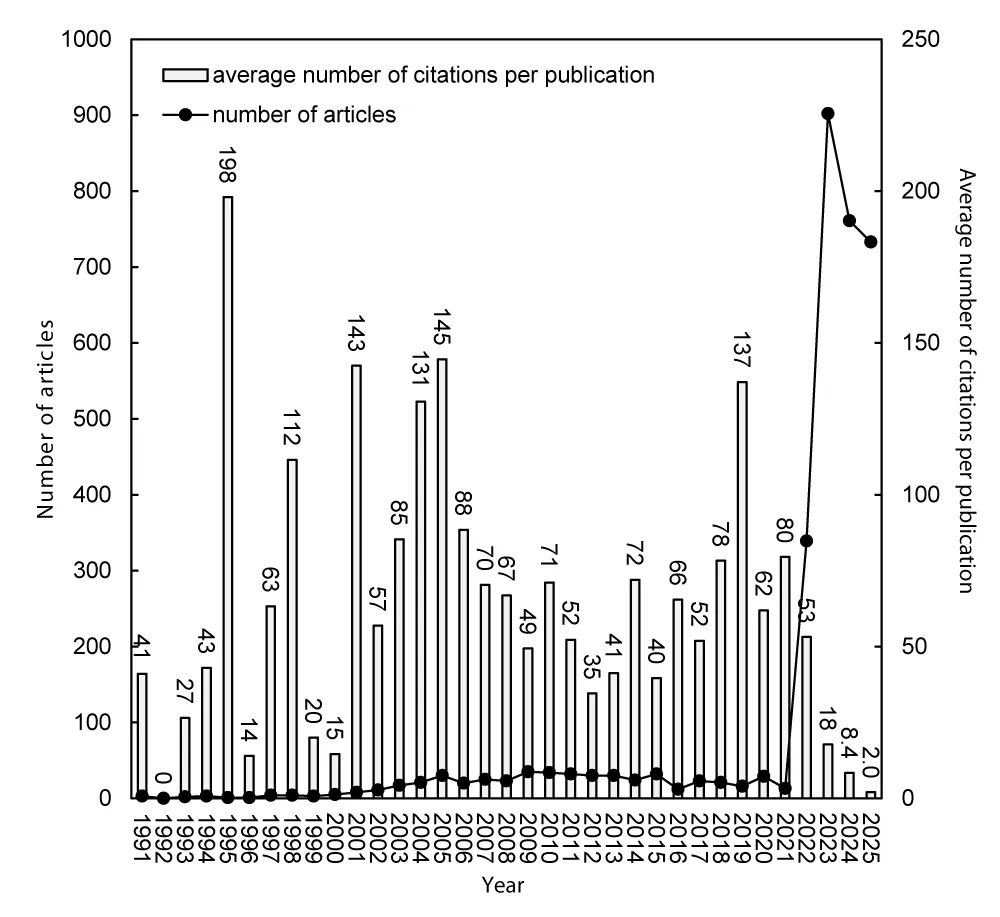
Monkeypox research has been a long monkeypox research since the 1960s. In recent years, after 2021, much more concern was raised (Figure 1). In the classic review by Bunge, et al. [25], a 10-fold increase in cases and the rising median age of patients were noted due to waning smallpox immunity. The first large-scale clinical series identified sexual contact as a primary driver of the 2022 outbreak [28]. Isidro, et al. [29] provided genetic proof that the 2022 virus (Clade IIb) was mutating faster than expected, suggesting adaptation to human hosts. Recent research focuses on the more severe Clade Ib variant, which triggered the 2024 WHO emergency declaration.
Web of Science Category and Journal Analysis
As of 2024, the Journal Citation Reports (JCR) indexed 9,454 journals across 178 categories within the SCI-EXPANDED database. Using the indicators proposed by Ho and Mukul [20], CPP2025 and APP, we analyzed the disciplinary distribution of monkeypox-related research across 122 WoS categories in the SCI-EXPANDED database, encompassing 788 unique journal entries.
As summarized in Table 2, the infectious diseases category, including 95 journals in 2024, was the most dominant, comprising 740 articles (23%). The general and internal medicine category contributed a substantial 180 articles and notably had the highest CPP2025 of 33 citations per publication, indicating a slightly significant citation impact. Research and experimental medicine publications showed the highest collaborative intensity, with an APP of 12 authors per publication, in contrast to pharmacology and pharmacy, which had the lowest collaboration index (APP = 7.1).
Table 3 presents the top 10 journals publishing monkeypox-related articles, along with their 2024 impact factor (IF2024), CPP2025, and APP values. Four of the top ten journals were categorized under immunology, reinforcing its central role in monkeypox scholarship. The Journal of Medical Virology (IF2024 = 4.6) led in publication volume with 114 articles (3.5%). The MMWR-Morbidity and Mortality Weekly Report (IF2024 = 17.3) stood out in terms of impact, with 63 articles and the highest CPP2025 of 58 citations per publication. By contrast, Scientific Reports (IF2024 = 3.9) published 67 articles, but with a lower CPP2025 of 10 citations. Authorship trends also varied across journals. The MMWR-Morbidity and Mortality Weekly Report had the highest APP at 22 authors per publication, indicating extensive collaborative networks, while Scientific Reports had the lowest at 7.6, suggesting a more modest scale of author collaboration.
Though not among the most prolific, high-impact journals also contributed to monkeypox-related research. The Lancet (IF2024 = 88.5; 1st in category of general and internal medicine) published 10 articles, the New England Journal of Medicine (IF2024 = 78.5; 2nd in category of general and internal medicine) published seven articles, Signal Transduction and Targeted Therapy (IF2024 = 52.7; 1st in category of biochemistry and molecular biology) published four articles, Nature Medicine (IF2024 = 50; 1st in category of research and experimental medicine) published 14 articles, Nature (IF2024 = 48.5; 2nd in category of multidisciplinary sciences) published six articles, Science (IF2024 = 45.8; 3rd in category of multidisciplinary sciences) published four articles, BMJ-British Medical Journal (IF2024 = 42.7; 5th in category of general and internal medicine) published three articles, and Cell (IF2024 = 42.5; 3rd in category of biochemistry and molecular biology) published nine articles. This shows that significant ideas related to mypox have been published in high-impact factor journals.
Publication Performances: Countries
First and corresponding authors are generally recognized as the principal contributors to a research article [30], with the corresponding author’s affiliation often serving as the institutional origin of the work [17].
Among the 3,247 monkeypox-related articles indexed in the SCI-EXPANDED database, 3,243 (99.9%) included identifiable country affiliations, representing contributions from 129 countries. Of these, 2,225 articles (69%) were single-country publications, authored by researchers from 76 countries, with a CPP2025 of 21 citations per publication. The remaining 1,018 articles (31%) were the result of international collaborations involving authors from 129 countries and demonstrated a significantly higher CPP2025 of 30 citations.
Table 4 compares the top 10 most productive countries with more than 100 articles, based on six publication performance indicators and their corresponding citation impact metrics [20]. The top 10 list includes five countries from Europe, three from Asia, and two from the Americas. Democratic Republic of the Congo, representing Africa, contributed 91 articles, ranking 12th globally. Australia, representing Oceania, contributed 76 articles, ranking 18th globally.
- The United States dominated all six publication indicatorsTotal articles (TP): 1,120 articles (35% of the total 3,243 articles),
- Single-country articles (IPC): 710 articles (32% of 2,225 single-country articles),
- Internationally collaborative articles (CPC): 410 articles (40% of 1,018 internationally collaborative articles),
- First-author articles (FP): 878 articles (27% of 3,243 first-author articles),
- Corresponding-author articles (RP): 911 articles (28% of 3,236 corresponding-author articles),
- Single-author articles (SP): 27 articles (33% of 83 single-author articles).
The United Kingdom, with 285 total articles, 69 single-country articles, 119 first-author articles, and 145 corresponding-author articles, recorded the highest overall CPP2025 (41 citations), single-author articles (63 citations), first-author articles (57 citations), and corresponding-author articles (53 citations). In contrast, Germany, contributing 119 internationally collaborative articles and two single-author articles, had the highest CPP2025 of 48 and 32 citations per publication for internationally collaborative articles and single-author articles, respectively.
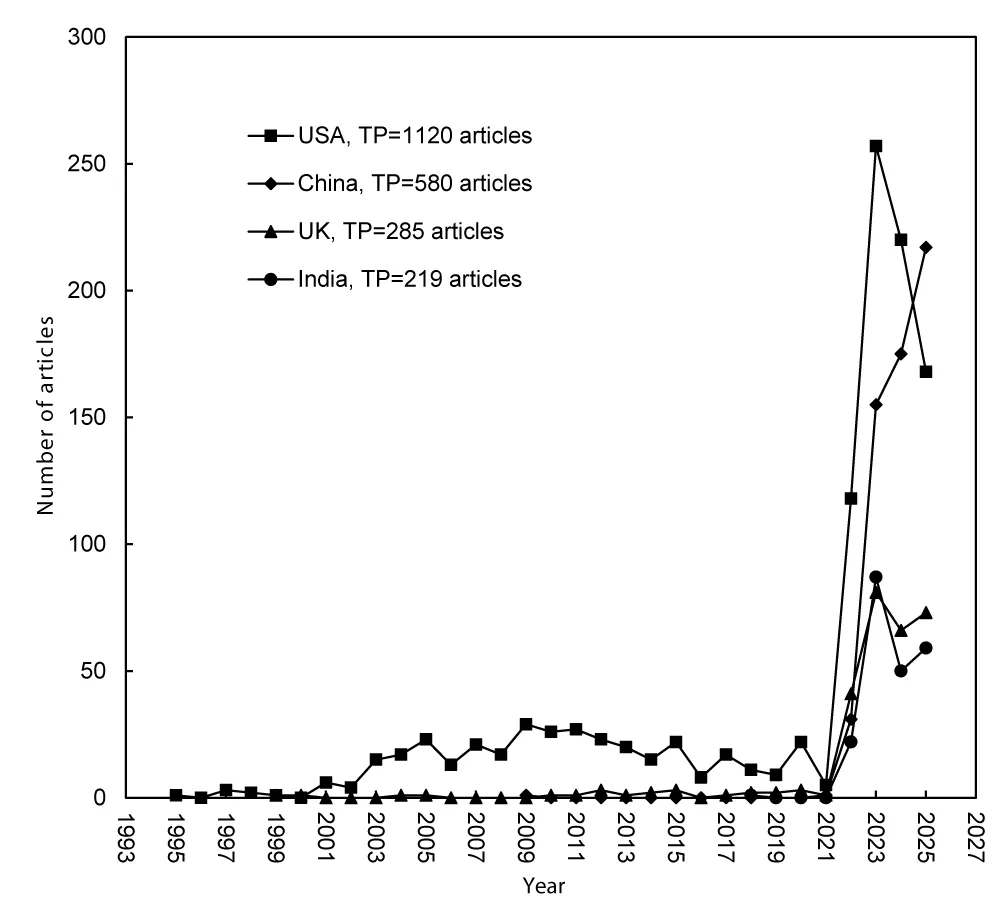
Figure 2 visualizes the publication trajectories of the four most productive countries (the USA, China, the UK, and Italy), each with over 200 articles. The USA led in annual publication output from 2001 to 2024, peaking at 257 articles in 2023. China published its first article in 2009 and another article in 2021. China’s rapid growth, particularly in the post-2021 period, reached 217 articles and ranked the top in 2025, reflecting increasing national investment in monkeypox research.
Publication Performances: Institutions
Of the 3,243 monkeypox-related articles with affiliation data, 647 (20%) were single-institution articles, yielding a CPP2025 of 24 citations per publication, whereas 2,596 (80%) resulted from inter-institutional collaborations, showing the same CPP2025 of 24 citations. Table 5 summarizes the top 10 most productive institutions, along with six publication indicators and corresponding CPP2025 values [20]. These institutions include five from the United States, two from China, and one each from the United Kingdom, the Democratic Republic of the Congo, and Saudi Arabia. Only four of the top ten institutions had single-author articles, including CDC (USA), NIAID (USA), KSU (Saudi Arabia), and UCLA (USA).
Centers for Disease Control and Prevention (USA) led in five of the six publication indicators:
- Total articles (TP): 252 articles (7.8% of the total 3,243 articles),
- Single-institution articles (IPI): 38 articles (5.9% of 647 single-institution articles),
- Inter-institutionally collaborative articles (CPI): 214 articles (8.2% of 2,596 inter-institutionally collaborative articles),
- First-author articles (FP): 178 articles (5.5% of 3,243 first-author articles),
- Corresponding-author articles (RP): 181 articles (5.6% of 3,236 corresponding-author articles).
Meanwhile, the Russian Academy of Sciences (Russia) and Katholieke Universiteit Leuven (Belgium) led in single-author articles, contributing three articles (3.6% of 83 single-author articles) in that category, respectively.
In terms of citation impact, the National Institute of Allergy and Infectious Diseases (USA) recorded the highest CPP2025 among the top ten institutions, with:
- CPP2025 of 110 citations per publication for all articles (TP = 41 articles),
- CPP2025 of 129 citations for single-institution articles (IPI = 7 articles),
- CPP2025 of 107 citations for inter-institutionally collaborative articles (CPI = 34 articles),
- CPP2025 of 94 citations for first-institution articles (SP = 23 articles).
The University of California, Los Angeles (USA) achieved the highest CPP2025 (91 citations) for corresponding-author articles (RP = 15 articles). The CDC (USA), with two single-author articles, recorded the highest CPP2025 of 114 citations for that document type.
Citation Histories of the Ten Most Frequently Cited Articles
To ensure temporal consistency and minimize bias associated with the evolving nature of citation metrics in the WoSCC, this study employed the total number of citations from the year of publication through the end of 2025 (TC2025), following the methodology proposed by Wang, et al. [8]. Among the 3,247 monkeypox-related articles indexed in SCI-EXPANDED, 2,548 articles (78%) included the search keyword in their title, indicating direct relevance to the topic. In contrast, 3,111 articles (99%) of the 3,153 articles with available abstracts included the term in their abstracts, and 1,831 articles (80%) of the 2,294 articles with author keyword metadata included the term in their author keywords. An in-depth analysis of the ten most frequently cited monkeypox-related articles revealed a notable pattern of keyword distribution. All of the ten articles included the search keywords in their title and abstract, respectively. Two articles included search keywords in their author keywords.
Table 6 presents a detailed list of the ten most frequently cited monkeypox articles, including both TC2025 and C2025 metrics. These two indicators allow us to differentiate between articles with long-term citation impact (high TC2025) and articles with current relevance (high C2025). I.K. Damon published two of the top ten articles, including one as the corresponding author. Interestingly, six articles from this list appear in both the top ten most cited overall (TC2025) and the top ten most cited in 2025 (C2025). This discrepancy reveals that long-term citation performance does not always align with present-day influence, underscoring the importance of dual-metric evaluation in bibliometric studies.
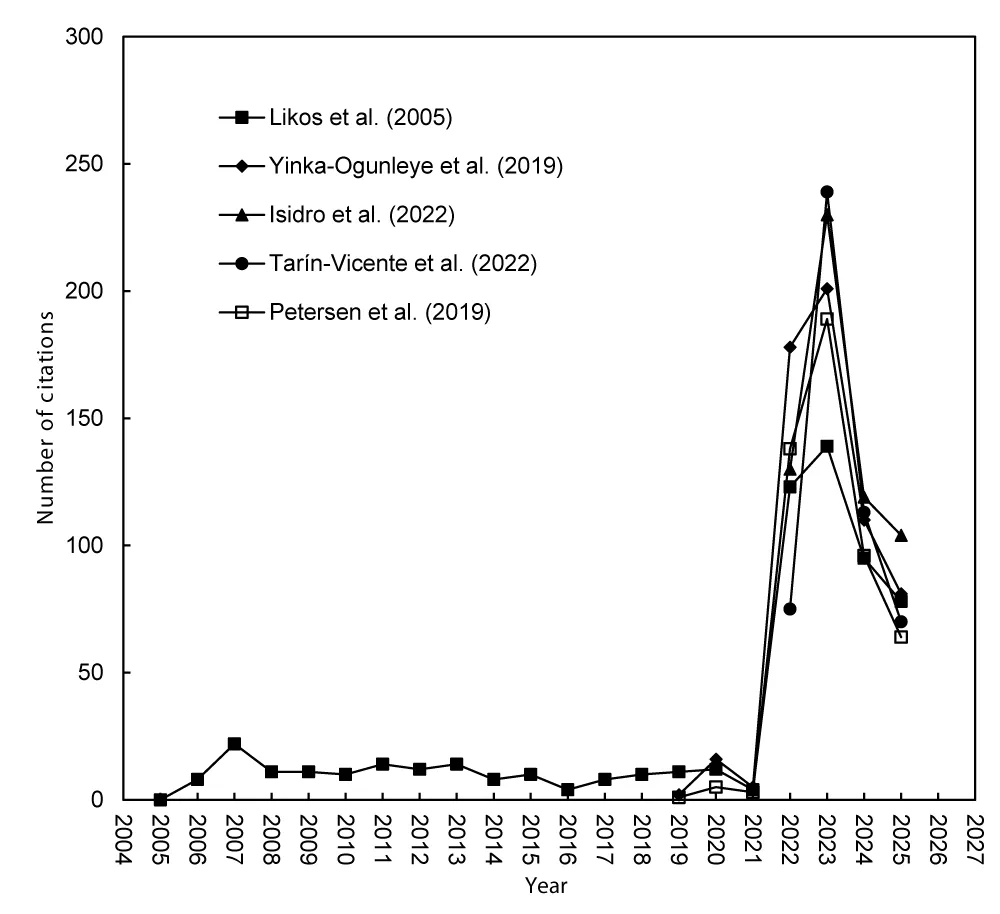
Figures 3 and 4 depict the annual citation trajectories of the ten most frequently cited articles. These six enduringly relevant articles, achieving both high TC2025 and C2025, are examined in detail below for their sustained scientific impact and contemporary relevance in monkeypox research.
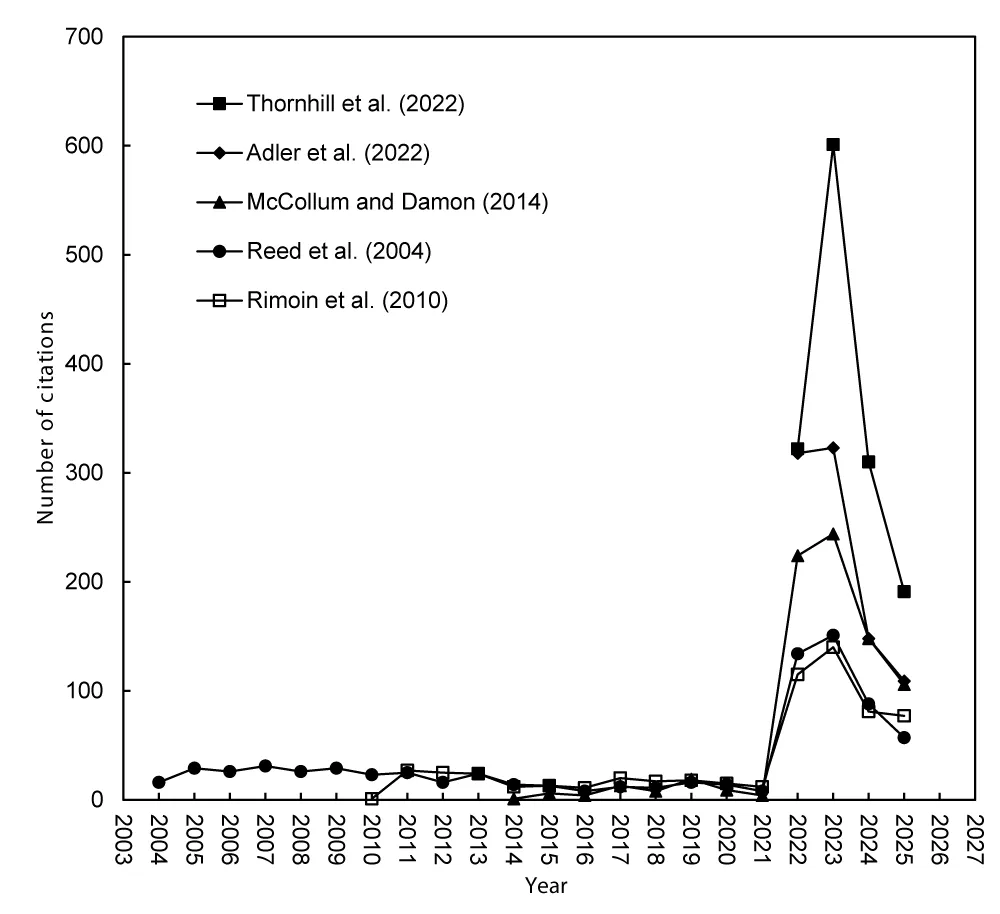
1. Monkeypox virus infection in humans across 16 countries - April-June 2022 [28]. The article published in the New England Journal of Medicine stands as the most highly cited monkeypox-related article with a TC2025 of 1,424 (ranked 1st) and C2025 of 191 (also 1st). Authored by 35 researchers from Queen Mary University of London in the UK. The authors presented an international collaborative group of clinicians who contributed to an international case series describing the presentation, clinical course, and outcomes of polymerase-chain-reaction–confirmed 528 monkeypox virus infections in 16 countries.
2. Clinical features and management of human monkeypox: A retrospective observational study in the UK [31]. The article ranks 2nd by TC2025 (898 citations) and 4th by C2025 (109 citations). Written by 24 authors from 14 institutions in the UK, Australia, and Sweden. This article discusses an observational retrospective study of MPXV in patients in the UK, including the treatment and clinical features of the disease. The authors highlight the need for prospective research on antivirals in humans and the importance of understanding the infectivity related to prolonged viral shedding. Finally, this review emphasizes the need for further research on antivirals and the importance of vigilance among healthcare workers.
3. Human monkeypox [32]. The article ranks 3rd by TC2025 (786 citations) and 5th by C2025 (106 citations) []. Authored by A.M. McCollum and I.K. Damon from the Centers for Disease Control and Prevention (USA). This document describes the main aspects of human monkeypox. In particular, it presents information on the emerging infection, its diagnosis, clinical symptoms, epidemiology, and challenges in controlling it.
4. A tale of two clades: monkeypox viruses [33]. The article ranks 6th by TC2025 (604 citations) and 9th by C2025 (78 citations). Authored by 17 authors from the Centers for Disease Control and Prevention (USA) and the WHO (Switzerland). This article describes the clinical, laboratory, and epidemiological features of human monkeypox cases from outbreaks in the USA and the Congo Basin, presents genomic sequencing of MPXV isolates confirming the existence of two distinct MPXV clades, and discusses the differences in predicted viral proteins between the two clades and their potential role in the observed differences in human pathogenicity. Finally, this highlights the importance of understanding MPXV molecular pathogenesis and epidemiology for improved prevention and control strategies.
5. Outbreak of human monkeypox in Nigeria in 2017-18: A clinical and epidemiological report [34]. The article ranks 7th by TC2025 (593 citations) and 8th by C2025 (81 citations). Authored by 50 authors from 17 institutions in Nigeria, the USA, Germany, and Switzerland. This article presents the temporal distribution of suspected, confirmed, and probable cases of human monkeypox, describes the demographic characteristics, fatality rate, and geographical distribution of cases, and presents the epidemiological links between cases, including household and prison clusters. Finally, it highlights the potential endemicity of the monkeypox virus in Nigeria and the possible reasons for its re-emergence and includes recommendations for future research and public health interventions.
6. Phylogenomic characterization and signs of microevolution in the 2022 multi-country outbreak of monkeypox virus [22]. The article ranks 8th by TC2025 (583 citations) and 6th by C2025 (104 citations). Authored by 17 authors from the National Health Institute Doutor Ricardo Jorge (INSA) and Lusofona University in Portugal. This article describes the largest MPOX outbreak to date, which was first identified in 2022.
The authors present the first MPXV outbreak genome sequences reconstructed using shotgun metagenomics, discuss the potential action of host APOBEC3 in viral evolution and signs of potential MPXV human adaptation, and highlight the utility of genome sequencing for tracking the spread and transmission of this outbreak.
As illustrated in Figures 3 and 4, these six articles initially experienced significant citation growth, which was followed by a marked decline in citations over the past two years. This decline may be attributed to general factors affecting scientific publications, such as the time window effect, delays in indexing, and changes in open access policies. Similarly, the citations of the top ten most frequently cited monkeypox articles have also decreased sharply in recent years. This reduction in citations during the latter period could be due to several factors. For instance, as interest in a topic normalizes, the pace of publication slows, leading to fewer citations. Another possibility is that following the global health emergency (2022-2023), the volume of publications on the subject may have peaked, and research is now transitioning into a phase of consolidating evidence. According to Ho (2014), citation trends of highly cited articles can vary significantly over time due to shifting research priorities, emerging methodologies, or the saturation of foundational knowledge.
This bibliometric study explored various databases to gather the pertinent information. The main limitations may relate to the format of the included materials, the scope and depth of the topic investigated, geographic and linguistic coverage, and the thoroughness of the search for ancient texts.
Conclusion
This bibliometric study delineates a robust and accelerating expansion in mpox literature, particularly following the 2022 global outbreak. By analyzing 6,052 documents from 1991 to 2025, the research identifies several key trends in the global scientific response to the monkeypox virus (MPXV). While research articles are the primary document type, review articles, such as the “classic” systematic review by Bunge, et al. [24], serve as foundational pillars for the field. Although Infectious Diseases is the most prolific research category, publications in General and Internal Medicine achieve the highest citation impact. The research landscape is characterized by the historical dominance of Western institutions, led by the United States in total publication volume and the United Kingdom in average citation impact. The Centers for Disease Control and Prevention (CDC) stands out as the most productive institution, while the US Army Medical Research Institute of Infectious Diseases maintains the highest citation density. The study captures a critical transition in research focus, from sporadic zoonotic cases in endemic African regions to the high-impact genomic and clinical studies of the 2022 multi-country outbreak. Recent trends also reflect a burgeoning global diversification, with countries like China showing rapid growth in annual output toward 2025. While citations for foundational papers have stabilized or declined as the 2022-2023 emergency period passed, the emergence of the Clade Ib variant continues to drive urgent research priorities. These findings offer a strategic roadmap for future investigation, highlighting the necessity of enhanced international collaboration and the integration of genomic surveillance to manage the persistent threat to global health security.
- Adnan N, Haq ZU, Malik A, Mehmood A, Ishaq U, Faraz M, et al. Human monkeypox virus: An updated review. Medicine (Baltimore). 2022;101(35):e30406. Available from: https://dx.doi.org/10.1097/MD.0000000000030406.
- Kandi V. Will mpox disease caused by the human Mpox virus (MPXV) result in a pandemic-like situation similar to the COVID-19 pandemic? Discov Public Health. 2024;21:137. Available from: https://dx.doi.org/10.1186/s12982-024-00262-2.
- Vakaniaki EH, Kacita C, Kinganda-Lusamaki E, et al. Sustained human outbreak of a new MPXV clade I lineage in eastern Democratic Republic of the Congo. Nat Med. 2024;30:2791. Available from: https://dx.doi.org/10.1038/s41591-024-03130-3.
- Martínez-Fernández DE, Fernández-Quezada D, Casillas-Muñoz FA, Carrillo-Ballesteros FJ, Ortega-Prieto AM, Jiménez-Guardeño JM, et al. Human monkeypox: A comprehensive overview of epidemiology, pathogenesis, diagnosis, treatment, and prevention strategies. Pathogens. 2023;12(7):947. Available from: https://dx.doi.org/10.3390/pathogens12070947.
- Yinda C, Koukouikila-Koussounda F, Mayengue P, et al. Genetic sequencing analysis of monkeypox virus clade I in Republic of the Congo: a cross-sectional, descriptive study. Lancet. 2024;404:1815. Available from: https://dx.doi.org/10.1016/S0140-6736(24)02188-3.
- Hatami H, Jamshidi P, Arbabi M, Safavi-Naini SA, Farokh P, Izadi-Jorshari G, et al. Demographic, epidemiologic, and clinical characteristics of human monkeypox disease pre- and post-2022 outbreaks: A systematic review and meta-analysis. Biomedicines. 2023;11(3):957. Available from: https://dx.doi.org/10.3390/biomedicines11030957.
- Ebede SO, Orabueze IN, Maduakor UC, Nwafia IN, Ohanu ME. Recurrent Mpox: divergent virulent clades and the urgent need for strategic measures including novel vaccine development to sustain global health security. BMC Infect Dis. 2025;25(1):536. Available from: https://dx.doi.org/10.1186/s12879-025-10896-5.
- Wang MH, Ho YS. Research articles and publication trends in environmental sciences from 1998 to 2009. Arch Environ Sci. 2011;5:1-10.
- Usman M, Ho YS. COVID-19 and the emerging research trends in environmental studies: A bibliometric evaluation. Environ Sci Pollut Res. 2021;28(14):16913-24. Available from: https://dx.doi.org/10.1007/s11356-021-13098-z.
- Ho YS, Lwesya F. Classic publications in food security research: A bibliometric analysis. World Food Policy. 2024;10(1):143-61. Available from: https://dx.doi.org/10.1002/wfp2.12066.
- Li Z, Ho YS. Use of citation per publication as an indicator to evaluate contingent valuation research. Scientometrics. 2008;75(1):97-110. Available from: https://dx.doi.org/10.1007/s11192-007-1838-1.
- Ho YS, Lwesya F. Research focuses and trends in food security: Bibliometric analysis. Sustain Dev. 2026;34(S1):297-317. Available from: https://dx.doi.org/10.1002/sd.70171.
- Al-Moraissi EA, Christidis N, Ho YS. Publication performance and trends in temporomandibular disorders research: A bibliometric analysis. J Stomatol Oral Maxillofac Surg. 2023;124(1):101273. Available from: https://dx.doi.org/10.1016/j.jormas.2022.08.016.
- Ho YS, Shekofteh M. Performance of highly cited multiple sclerosis publications in the Science Citation Index expanded: A scientometric analysis. Mult Scler Relat Disord. 2021;54:103112. Available from: https://dx.doi.org/10.1016/j.msard.2021.103112.
- Monge-Nájera J, Ho YS. Bibliometry of Panama publications in the Science Citation Index Expanded: Publication type, language, fields, authors and institutions. Rev Biol Trop. 2015;63(4):1255-66. Available from: https://dx.doi.org/10.15517/rbt.v63i4.21112.
- Chong YM, Long X, Ho YS. Scientific landscape and trend analysis of keloid research: A 30-year bibliometric review. Ann Transl Med. 2021;9(11):945. Available from: https://dx.doi.org/10.21037/atm-21-508.
- Ho YS. Top-cited articles in chemical engineering in Science Citation Index Expanded: A bibliometric analysis. Chin J Chem Eng. 2012;20(3):478-88. Available from: https://dx.doi.org/10.1016/S1004-9541(11)60209-7.
- Ho YS. The top-cited research works in the Science Citation Index Expanded. Scientometrics. 2013;94(3):1297-312. Available from: https://dx.doi.org/10.1007/s11192-012-0837-z.
- Hsu YHE, Ho YS. Highly cited articles in health care sciences and services field in Science Citation Index Expanded: A bibliometric analysis for 1958-2012. Methods Inf Med. 2014;53(6):446-58. Available from: https://dx.doi.org/10.3414/ME14-01-0022.
- Ho YS, Mukul SA. Publication performance and trends in mangrove forests: A bibliometric analysis. Sustainability. 2021;13(22):12532. Available from: https://dx.doi.org/10.3390/su132212532.
- Monge-Nájera J, Ho YS. El Salvador publications in the Science Citation Index Expanded: subjects, authorship, collaboration and citation patterns. Rev Biol Trop. 2017;65(4):1428-36. Available from: https://dx.doi.org/10.15517/rbt.v65i4.28397.
- Giannoudis PV, Chloros GD, Ho YS. A historical review and bibliometric analysis of research on fracture nonunion in the last three decades. Int Orthop. 2021;45:1663-76. Available from: https://dx.doi.org/10.1007/s00264-021-05020-6.
- Ho YS, Fardi A, Kodonas K. A bibliometric approach to understanding trends and major topics in cone beam computed tomography research. J Stomatol Oral Maxillofac Surg. 2026;127(4):102769. Available from: https://dx.doi.org/10.1016/j.jormas.2026.102769.
- Long X, Huang JZ, Ho YS. A historical review of classic articles in the surgery field. Am J Surg. 2014;208(5):841-9. Available from: https://dx.doi.org/10.1016/j.amjsurg.2014.03.016.
- Bunge EM, Hoet B, Chen L, Lienert F, Weidenthaler H, Baer LR, et al. The changing epidemiology of human monkeypox-A potential threat? A systematic review. PLoS Negl Trop Dis. 2022;16(2):e0010141. Available from: https://dx.doi.org/10.1371/journal.pntd.0010141.
- Usman M, Ho YS. A bibliometric study of the Fenton oxidation for soil and water remediation. J Environ Manag. 2020;270:110886. Available from: https://dx.doi.org/10.1016/j.jenvman.2020.110886.
- Ho YS, Satoh H, Lin SY. Japanese lung cancer research trends and performance in Science Citation Index. Intern Med. 2010;49(20):2219-28. Available from: https://dx.doi.org/10.2169/internalmedicine.49.3687.
- Thornhill JP, Barkati S, Walmsley S, Rockstroh J, Antinori A, Harrison LB, et al.. Monkeypox virus infection in humans across 16 countries - April-June 2022. N Engl J Med. 2022;387(8):679-91. Available from: https://dx.doi.org/10.1056/NEJMoa2207323.
- Isidro J, Borges V, Pinto M, Sobral D, Santos JD, Nunes A, et al. Phylogenomic characterization and signs of microevolution in the 2022 multi-country outbreak of monkeypox virus. Nat Med. 2022;28(8):1569-72. Available from: https://dx.doi.org/10.1038/s41591-022-01907-y
- Riesenberg D, Lundberg GD. The order of authorship: Who’s on first. JAMA. 1990;264(14):1857. Available from: https://dx.doi.org/10.1001/jama.264.14.1857.
- Adler H, Gould S, Hine P, Snell LB, Wong W, Houlihan CF, et al. Clinical features and management of human monkeypox: A retrospective observational study in the UK. Lancet Infect Dis. 2022;22(8):1153-62. Available from: https://dx.doi.org/10.1016/S1473-3099(22)00228-6.
- McCollum AM, Damon IK. Human monkeypox Helicobacter pylori eradication therapy. Clin Infect Dis. 2014;58(2):260-7. Available from: https://dx.doi.org/10.1093/cid/cit703.
- Likos AM, Sammons SA, Olson VA, Frace AM, Li Y, Olsen-Rasmussen M, et al. A tale of two clades: monkeypox viruses. J Gen Virol. 2005;86:2661-72. Available from: https://dx.doi.org/10.1099/vir.0.81215-0.
- Yinka-Ogunleye A, Aruna O, Dalhat M, Ogoina D, McCollum A, Disu Y, et al. Outbreak of human monkeypox in Nigeria in 2017-18: A clinical and epidemiological report. Lancet Infect Dis. 2019;19(8):872-9. Available from: https://dx.doi.org/10.1016/S1473-3099(19)30294-4.
- Petersen E, Kantele A, Koopmans M, Asogun D, Yinka-Ogunleye A, Ihekweazu C, et al. Human monkeypox epidemiologic and clinical characteristics, diagnosis, and prevention. Infect Dis Clin North Am. 2019;33(4):1027-70. Available from: https://dx.doi.org/10.1016/j.idc.2019.03.001.
- Reed KD, Melski JW, Graham MB, Regnery RL, Sotir MJ, Wegner MV, et al. The detection of monkeypox in humans in the Western Hemisphere. N Engl J Med. 2004;350(4):342-50. Available from: https://dx.doi.org/10.1056/NEJMoa032299.
- Rimoin AW, Mulembakani PM, Johnston SC, Lloyd-Smith JO, Kisalu NK, Kinkela TL, et al. Major increase in human monkeypox incidence 30 years after smallpox vaccination campaigns cease in the Democratic Republic of Congo. Proc Natl Acad Sci U S A. 2010;107(37):16262-7. Available from: https://dx.doi.org/10.1073/pnas.1005769107.
- Tarín-Vicente EJ, Alemany A, Agud-Dios M, Ubals M, Suñer C, Antón A, et al. Clinical presentation and virological assessment of confirmed human monkeypox virus cases in Spain: A prospective observational cohort study. Lancet. 2022;400(10353):661-9. Available from: https://dx.doi.org/10.1016/S0140-6736(22)01436-2.


 Save to Mendeley
Article Alerts
Subscribe to our articles alerts and stay tuned.
 This work is licensed under a Creative Commons Attribution 4.0 International License.