International Journal of Clinical Endocrinology and Metabolism
60-Year-Old Man with Pheochromocytoma and Clinical Picture of Depression
1Department of Internal Medicine and Endocrinology, Medical University of Warsaw, Warsaw, Poland
2Department of Histology and Embryology, Center for Bio structure Research, Medical University of Warsaw and Postgraduate School of Molecular Medicine, Warsaw, Poland
Author and article information
Cite this as
Rak B, Brodzińska K, Kępczyńska-Nyk A, Ambroziak U (2016) 60-Year-Old Man with Pheochromocytoma and Clinical Picture of Depression. Int J Clin Endocrinol Metab. 2016; 2(1): 16-18. Available from: 10.17352/ijcem.000016
Copyright License
© 2016 Rak B, et al. This is an open-access article distributed under the terms of the Creative Commons Attribution License, which permits unrestricted use, distribution, and reproduction in any medium, provided the original author and source are credited.Introduction: Pheochromocytoma is an adrenal gland tumour, which usually produces catecholamines. The classical triad of clinical symptoms consists of palpitations, headaches nd profuse sweating. Other symptoms include: hypertension, anxiety, pallor, nausea, weakness. However, it can be asymptomatic. Because of unspecific symptoms the diagnosis of this rare neuroendocrine tumor can be missed or delayed. In differential diagnosis other entities should be considered: essential hypertension, anxiety attack, hyperthyroidism, hypogonadism, hypoglycemia, renal artery stenosis, intracranial lesion, autonomic epilepsy, carcinoid syndrome, use of cocaine or amphetamine.The final diagnosis is based on biochemical testing of urine or plasma metanephrines and imaging examination (CT, MRI). Although huge improvement in biochemical testing is observed in case of lack of symptoms or nonspecific clinical picture, false positive biochemical results should be excluded.
Case: This study reports a 60-year-old man admitted to the hospital because of a left drenal tumor (35 x 30mm) found incidentally during abdominal ultrasound examination. The patient complained only of profuse sweating on exertion. He has been treated for hypertension for two years and for depression for 7 years. There was no abnormalities in physical examination. Endocrine work-up revealed elevated urine metanephrines and urine noradrenaline, observed both before and after adrenal surgery. Histopathology report confirmed pheochromocytoma. To exclude drug interferences, depression medication after surgery was withdrawn for one month and repeated results of metanephrines and oradrenaline were normal. As the patient was in good condition with no deterioration of his motional status clomipramin and minaserin were kept withdrawn and the patients remains without medication.
Conclusion: This case report shows that clinical picture of pheochromocytoma can mimic depression. Diagnosis of pheochromocytoma in patient with depression on medication may be difficult,especially when comes to the assessment of the cure after surgery.
Pheochromocytoma (Pheo) is a tumor that derives from adrenomedullary chromaffin cells which produces mainly catecholamines. It may occur at any age. Pheo is potentially life-threatening disorder that accounts approximately 2-3% incidentally found adrenal lesions. More than 25% of patients with pheochromocytomas have germ line mutation in one of the genes: RET, NF-1, VHL and succinate dehydrogenase complex: SDHB, SDHC, SDHD [1,2].
Usually patients with pheo present with paroxysmal or sustained hypertension. Pheo can be however asymptomatic. The classical triad of symptoms consists of palpitations, headaches and profuse sweating. Other symptoms include: anxiety, pallor, nausea, weakness.
Case Presentation
A 60 -year- old man was admitted to the hospital, because of a left adrenal tumor incidentally found during abdominal ultrasound (US). The examination was performed as a follow-up of a prostate hypertrophy. The presence of the adrenal mass was confirmed on computed tomography (CT), which showed 35x30 mm tumor with native density of 40 Hounsfield’s units, what spoke against adrenal adenoma. He has been treated for hypertension for two years with losartan and amlodipine, hyperlipidemia with simvastatin and depression for 7 years with clomipramine and mianserin. The patient complained only of profuse sweating on exertion. The patient presented no symptoms and signs of hypercortisolemia or feminization. He also denied heart palpitation, headache, and weight loss or muscle weakness. There were no abnormalities in physical examination.
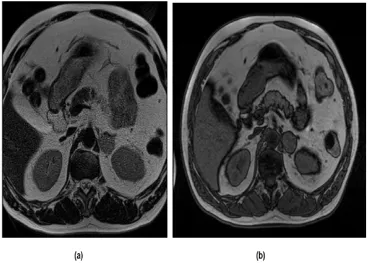
As a further imaging work-up magnetic resonance imaging (MRI) was done and revealed left adrenal tumor 25x30mm, without signal loss in out-of-phase what again spoke against adrenal adenoma (Figure 1). The endocrine and biochemical measurements were normal, beside diurnal urinary metanephrines and noradrenaline excretion which was significantly elevated (Table 1). We were aware of possibility of drugs interference with catecholamine measurements. The decision about surgery was however undertaken mainly because of imaging tumor phenotype not corresponding to adenoma, so to avoid patients’ emotional status deterioration before operation the measurements were not repeated after drugs withdrawal. Diagnosis of pheochromocytoma was however likely, so the patient was prepared to surgery with alfa- adrenolitics.
After surgical consultation, the patient was qualified to transperitoneal laparoscopic excision of the tumor. Histopathology report confirmed the diagnosis of pheochromocytoma. Genetic testing was negative towards RET, VHL and SDH mutations. After surgical intervention profuse sweating relieved, no other symptoms were present at that time. The patient still required antihypertensive medication. To assess complete chromaffin tissue excision, one month after surgery metanephrines and catecholamines were measured. 24h urine collection showed elevated level of metanephrines and noradrenaline, however lower than before the operation (Table 2). As this could be an effect of interference with antidepressant drugs, to avoid unnecessary imaging studies stressful for the patient, the decision about drugs withdrawal was undertaken to repeat the measurements (the psychiatric consultation was objective). After 1 month of “drugs wash-out” the measurements of diurnal urinary metanephrines and noradrenaline were normal (Table 2). As the patient was in good condition with no deterioration of his emotional status clomipramine and minaserin were kept withdrawn and the patients remains without medication.
Discussion
Here, we have presented patient with depressive symptoms, which unmask pheochromocytoma. Typical spells with triad of symptoms i.e. headache, sweating and heart palpitation or tachycardia occur quite rare. Other common symptoms include: tremor, pallor, and nausea or vomiting, diaphoresis, episodic anxiety, asymptomatic hyperglycemia, abdominal or chest pain. It is essential to identify patients with pheochromocytoma as undetected tumors may cause severe life-threatening condition i.e. heart attack, brain ischemia, arrhythmias, kidney failure, dissecting aorta aneurism or irreversible shock [3-5]. Conditions, which should be considered in differential diagnosis include: essential hypertension, anxiety attack, hyperthyroidism, hypogonadism, hypoglycemia, renal artery stenosis, intracranial lesion, autonomic epilepsy, carcinoid syndrome, use of cocaine or amphetamine [1,6]. Our patient presented with well controlled hypertension and sweating only on exertion. Hypertension in pheochromocytoma patients is considered to be typical manifestation [7]. It occurs in about 90% of cases and among them 50% suffer from paroxysms of severe hypertension. On the other hand, some patients may present with well controlled hypertension between hypertension paroxysms. Moreover, in about 14% of cases phenomenon called tachyphylaxis may be present, caused by constantly high norepinephrine levels, which leads to tolerance. In that rare condition, there is no hypertension in patients affected by pheochromocytoma. Sweating in pheochromocytoma occurs late during the paroxysm. It is a result of thermoregulatory reflex in response to prolonged vasoconstriction. Furthermore, in some patients can be observed unexplained sustained fever [2,8,9].
Neurological and psychiatric disorders should not be omitted. Depressive and anxiety disorders can be provoked by the presence of symptoms of pheochromocytoma but also may mimic pheochromocytoma [10,11]. However, panic attacks are often associated with symptoms frequent in pheochromocytoma like: tachycardia, chest discomfort or tachypnoe [12-14]. The rarity of pheochromocytoma shifts the diagnosis towards psychiatric disorders. In our patient depressive symptoms were likely caused by pheochromocytoma, what the patient and us realized after antidepressive medication withdrawal after surgery. Many medication can interfere with metanephrines and catecholamines measurements. The most commonly mentioned include sotalol, labetalol, tricyclic antidepressants, MAO inhibitors, anesthetics, cocaine, lidocaine and acetaminophen. Morover smoking, caffeine, renal failure or other stressfull illness may result in elevated plasma levels of metanephrines [12,15]. This can make the diagnosis difficult but also, as in our case may lead to confusion about complete remission after surgery.
Our patient presented with both true overproduction of calecholamines and false connected to the treatment applied. Beside biochemical intereference, some symptoms may be a consequence of antidepressant therapy. In the literature, there are reports, which shows pheo attacks provoked by antidepressant therapy [3,16]. Ferguson reported a case of 35-year-old man with pheochromocytoma who developed crisis with cardiac shock, shortly after beginning of imipramine therapy.
To ultimately define, whether the increased level of catecholamines is caused by antidepressant drugs it is necessary to discontinue therapy for at least 1 month.
Conclusion
The clinical picture of pheochromocytoma can mimic depression. Diagnosis of pheochromocytoma in patients on antidepressants may be difficult, especially when patient presents only with unspecific symptoms and when comes to the assessment of the cure after surgery.
- Longo DL, Fauci AS, Kasper DL, Hauser SL, Jameson JL, et al. (2012) Harrison’s Principles of Internal Medicine18th edition, 2: 2962-2967 .
- Greespan FS, Gardner DG (2003) Basic & Clinical Endocrinology 7th edition 453-472 .
- Ferguson KL (1994) Imipramine-provoked paradoxical pheochromocytoma crisis: a case of cardiogenic shock. Am J Emerg Med 12:190-192 .
- Li SJ, Wang T, Wang L, Pang ZQ, Ma B, et al. (2016) Ventricular Tachycardia and Resembling Acute Coronary Syndrome During Pheochromocytoma Crisis: A Case Report. Medicine (Baltimore) 95: e3297 .
- Darze ES, Von Sohsten RL (2004) Pheochromocytoma-induced segmental myocardial dysfunction mimicking an acute myocardial infarction in a patient with normal coronary arteries. Arq Bras Cardiol 82:178–180 .
- Mann SJ (1999) Severe Paroxysmal Hypertension (Pseudopheochromocytoma): understanding the cause and treatment. Arch Intern Med 159: 670-674 .
- Mann SJ (2008) Severe paroxysmal hypertension (pseudopheochromocytoma). Curr Hypertens Rep 10:12-18 .
- Meseeha MG, Sattur S (2016) Acute systolic heart failure and uncontrolled hypertension: what is the missing link? Postgrad Med 128:722-724 .
- Fassnacht M, Arlt W, Bancos I, Dralle H, Newell-Price J, et al. (2016) Management of adrenal incidentalomas: European Society of Endocrinology Clinical Practice Guideline in collaboration with the European Network for the Study of Adrenal Tumors. Eur J Endocrinol 175: 1-34 .
- Zardawi IM (2013) Phaeochromocytoma masquerading as anxiety and depression. Am J Case Rep 14: 161-163.
- Papadopoulos DP, Mourouzis I, Votteas V, Papademetriou V (2010) Depression masked as paroxysmal hypertension episodes. Blood Press 19: 16-19 .
- Teixeira J, Almeida M, Afonso M, Pinto A (2015) Much more than anxiety... BMJ Case Rep 5: 2015 .
- Páll A, Becs G, Erdei A, Sira L, Czifra A et al. (2014) Pseudopheochromocytoma induced by anxiolytic withdrawal. Eur J Med Res 19: 53 .
- Anderson NE, Chung K, Willoughby E, Croxson MS (2013) Neurological manifestations of phaeochromocytomas and secretory paragangliomas: a reappraisal. J Neurol Neurosurg Psychiatry 84 :452-457 .
- Lenders JW, Duh QY, Eisenhofer G, Gimenez-Roqueplo AP, Grebe SK, et al. (2014) Pheochromocytoma and paraganglioma: an endocrine society clinical practice guideline. Endocrine Society. J Clin Endocrinol Metab 99: 1915-1942 .
- Saporito F, Andò G, Di Bella G, Oreto G (2014) Acute heart failure due to pheochromocytoma crisis after levosulpiride administration. Int J Cardiol 175: 383-384 .


 Save to Mendeley
Article Alerts
Subscribe to our articles alerts and stay tuned.
 This work is licensed under a Creative Commons Attribution 4.0 International License.