Sociodemographic Characteristics of Occupational Burns Injuries at a Regional Hospital in Havana
1Plastic and Burns Department, University Hospital Calixto García. Havana. Cuba
2Research Department, University Hospital Calixto García. Havana. Cuba
Author and article information
Cite this as
Castillo DZ, et al. Sociodemographic Characteristics of Occupational Burns Injuries at a Regional Hospital in Havana. Open J Trauma. 2026; 10(1): 8-11. Available from: 10.17352/ojt.000054
Copyright License
© 2026 Castillo DZ, et al. This is an open-access article distributed under the terms of the Creative Commons Attribution License, which permits unrestricted use, distribution, and reproduction in any medium, provided the original author and source are credited.Background: Occupational burn injuries are dramatic accidents and can lead to severe damage to health, with a negative impact on patients economical, social, and labor status. With the aim of determining the epidemiological characteristics of occupational burns in a regional hospital in Havana, the present study was carried out.
Methods: A descriptive, prospective and cross-sectional investigation was performed at the Burn Department of the University Hospital “General Calixto García¨, from January 2023rd to July 2024th. All admitted patients with a diagnosis of work-related burns with any severity grade and aged between 19 and 60 years were included. Patients with accidental domestic burns were excluded. Sociodemographic characteristics and associated occupational activities were identified.
Results: 67 patients were studied. Males were the predominant group. (88%) And patients between 30 and 49 years old are the most affected. (64.1%). With an average age of 34± 12.6. Scalds and flames are the main etiological agents found, and Food elaborators (34%) the first occupational activity detected. 31.3 % of patients developed complications, and 96 % survived. Hospital Length of Stay was higher in the group classified as Major Burns, with a Mean of 36,5 ± 12,2 days.
Conclusions: Occupational accidents represent one of the first modes of burn injury production, leading to severe complications. Working adult men are predominantly affected. The discharge status and hospital length of Stay have a direct relationship with the severity of the burn injury.
Occupational Burns are a Health problem all around the world, and one of the main causes of morbidity and accidental mortality [1]. According to the World Health Organization (WHO), about 240 million people suffered from burn injuries in 2021st, and an average of 180 thousand people die every year as a consequence of thermal accidents [2,3].
Different risk factors are associated with the severity of burns, including coexisting comorbidities, age, etiological agents, and production modes [3,4]. The extent of the Total Body Surface Area (TBSA) affected and the depth of the burn wound are considered to be determinant aspects for the patient outcome [5,6]. A secondary bacterial colonization appears as a consequence of the rupture of the protective skin barrier. Healing of the anatomic zones involved seems to be a complex process [7,8]. An effective and early therapeutic approach includes fluid repositioning, nutritional support, antibiotics, and a proper surgical technique, such as wound debridement and skin grafting, in order to avoid complications [9]. The development of pathological healing, contractures, and functional disability affects the social and work reintegration with a negative economic impact for the patient, his family, and society [10].
Occupational accidents remains to be one the first burn injury production modes, leading to prolonged hospitalization, activity impairment, psychological and aesthetic sequels [11]. Neglected behaviours, lack of protection protocols and safety measures in the labour environment have been described as factors related to this type of injury [12,13].
During the last decades, educational preventive guidelines have been developed in order to diminish the incidence of occupational burn accidents. A better understanding of the prevalence and complication rates of work-related burns is important to improve workers’ quality of life [14,15].
With the aim of describing the epidemiological characteristics of occupational burns at the University Hospital Calixto García, the present research was performed.
Methods
An observational, descriptive, cross-sectional and prospective study was carried out at the Burn Department of the University Hospital Calixto García, Havana, Cuba, from January 2023rd to June 2024th. All admitted patients between 19 and 60 years old, with any severity grade of burn injury according to the Cuban Burn Classification Scale [5] and accidental occupational burns as a production mode were included.
Patients diagnosed with domestic accidental burns were excluded.
Of a total of 262 admitted patients, 67 were included. (20.6%)
Data Collection. Information was obtained from medical records.
Ethics aspects
The research was conducted according to the Helsinki Declaration (Medical World Association). 2024th and approved by the Ethics Committee of the Hospital. Signature of written Informed Consent was obtained from all studied patients.
Statistical analysis
Data were collected and analyzed using Excel and SPSS software (versión 22.0) for Windows. Continuous variables were presented as Means (X) and Standard Deviation. Frequencies and categorical variables were expressed as percentages (%). with p< 0.05 for statistical significance.
Results
67 patients were included. The demographic characteristics of the sample are presented in Table 1.
Males were predominant (88%). The age group between 30 and 49 years old is the most affected, with a Mean of 34 ± 12.6.
About the mortality rate: 2 male patients died (4%) as a consequence of complications. (1 suffered from a Lung Tromboembolism (1.5%) and 1 died as a consequence of a septic shock 1.5%).
A total of 31.3 % of patients developed complications (Chart 1).
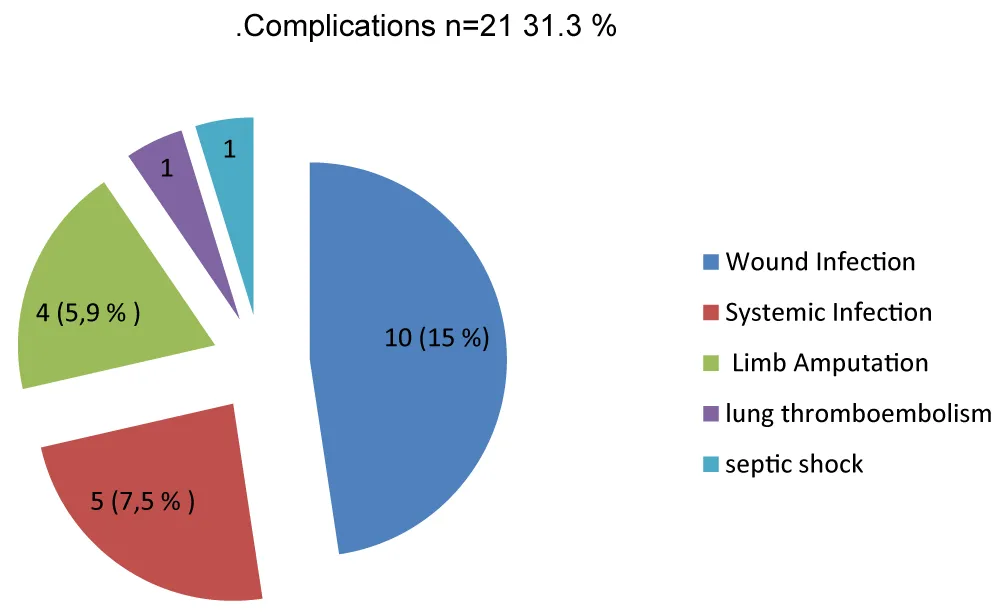
Font: Medical Records. p< 0.05
Other complications were identified: wound infection (n= 10), systemic infection (n=5), and limb amputations (n=4).
The 4 surgical amputations (5.9%) were performed as a consequence of high-voltage electricity burns. (2 upper and 2 lower limbs were affected.)
Table 2 shows the occupational activities and their relations with the etiological agents.
Scalds and Flames (25.4% each one) were the main etiological agents found, and Food elaborators were the principal affected occupational group. (n=23 34%), followed by mechanics.
High Voltage Electricity Burns (17.9%), Hot Metals (15,6%) and Caustic Agents (12%) other etiological agents detected .
About the severity of the burn injury, an elevated number of patients (67,2%) suffered from Minor Burns (<10% of Total Body Surface Area burned), while 32.8 % of them were classified as Major Burns injured. (Table 3).
An association between the severity of the burn injury and the hospital length of stay was confirmed.
A Mean value for Hospital Length of Stay of 36,5 ± 12,2 days was demonstrated for Major Burns , and 21,4 ± 6,8 days for minor burns, with an statistical significance ( p<0,05) .
Discussion
In spite of a lack of statistical reports about workplace burn accidents, some population groups seem to have a higher susceptibility to suffer from this kind of condition [14,16]. Toxic habits such as alcohol intake and cigar smoking at the workplace have been detected as associated factors in the production of accidental burns [15,17]. Several researchers reveal a higher incidence of occupational burns in adult males [13,14]. In a study conducted by Reichard AA et al [17], the prevalence of adult males was confirmed. In a retrospective study, Abarca et al [18] report an incidence of 14.1 % of burn accidents at work place and men being the most injuried.
In the present research, a mean age of 34 ± 12,6 years old was detected mainly in men. Scalds and flames are the main causal agents found.
In line with our results, Jung WS et al [13] also describe a higher prevalence of workplace burns in males (62.2%), considering an average age of 46.2 ±14.9 years old, and scalds as the first ethiological agent.
Toolaroud PB et al [14] report a proportion of 7.25 affected males for each burn injuried female patient (7.25/1) ,an average age of 37.53 years old, and flame as the predominant etiological agent related with occupational activities.
The ignition of clothes and contact with boiling fluids have been considered to be associated with work-related burns [16]. Orozco Gómez et al [19] carried out a 3-year prospective study with 16.8% of electricity company workers injured by burns. Other authors [10,12,20] also demonstrate a significant incidence of high-voltage electricity burns in electricity company workers.
Food manufacturing workers appear to be one of the most injured by accidental burns and scalding, as the first burn production mechanism [11]. Chemical agents have been reported to produce burns at the workplace as well [21].
The depth of the damaged tissue will determine the therapeutic approach. The development of complications is the rule [9,13,21]. Systemic and wound bacterial infection was demonstrated as the principal complication in 22.5% of our series. Loss of the cutaneous protective barrier, the need for multiple surgeries, and prolonged hospitalization lead to a bloodstream infection. The presence of comorbidities and the extent of the burn wound are related to the outcome [22].
A Total Body Surface Area (TBSA) higher than 20% of burns is associated with the poorest prognosis [5,17,23]. According to several studies [11,13,21,24], occupational Burns classified as minor were the majority. In our selected sample, minor burns (<10% of TBSA) accounted for 67.2%. For this group, the hospital length of stay had a Mean value of 21.4±6.8 days with a statistical significance p=0.006
Some other issues have been investigated by Nurczyck K et al [25], describing the principal anatomic zones involved in occupational burns, pointing to the upper limbs as the most affected (28.7%). Scarring problems, physical sequels, and activity impairment are challenges for patients’ social and work reintegration [26]. Some preventive guidelines must be implemented at work place as identifying potential hazards, with the aim of reducing the incidence of accidents. Educational communications programs can play an important role in changing lifestyles, such as cigar smoking while working, handling caustic substances, boiling fluids, hot metals, or electrical sources [11,15,27].
Once the occupational accident has been identified, a proper assessment of the severity of the burn injury is the key to early delivery to a medical center. Adequate management of the burn wound and patient stabilization will lead to a successful outcome [27,28].
A relatively small sample size (n=67) was obtained in the present research because of a short period of time studied (one and a half years), in the absence of regional statistical reports involving work-related burns, representing a limitation. We consider that future studies should be performed for a longer period of time in order to evaluate the epidemiology of burns associated with occupational activities.
Conclusions
Occupational accidents represent one of the first burn injury production modes leading to severe complications. Working adult men are predominantly affected. The discharge status and Hospital Length of Stay showed a close association with the severity of the burn injury. Although a low prevalence of occupational burn accidents has been confirmed by scientific articles, work-related burns still represent a worldwide health problem. Proper safety preventive guidelines must be applied in order to improve workers’ quality of life.
- Feng B, Liu X, Shi Y, Jiang M, Chen Y, Wang Z, et al. Epidemiological features and temporal trends of burns and their subtypes: findings from the Global Burden of Disease Study. Regen Repair Rehabil. 2025;1(2):38-50. Available from: https://doi.org/10.1016/j.rerere.2025.01.002
- Mehta K, Arega H, Smith NL, Li K, Gause E, Lee J, et al. Gender-based disparities in burn injuries, care and outcomes: a World Health Organization (WHO) Global Burn Registry cohort study. Am J Surg. 2021;07:041. Available from: https://doi.org/10.1038/s41598-023-40198-2
- Lee N, Bae Y, Jang S, Lee DW, Lee SW. Global, regional, and national burden of burn injury by total body surface area involvement from 1990 to 2021, with projections of prevalence to 2050. Healthcare (Basel). 2025;13(16):2077. Available from: https://doi.org/10.3390/health13162077
- Mohammadi AA, Hoghoughi MA, Karoobi M.Ranjbar K, Shahriarirad R, Erfani A, et al. Socioeconomic features of burn injuries in Southern Iran: a cross-sectional study. J Burn Care Res. 2022;43:936-941. Available from: https://doi.org/10.1093/jbcr/irab227
- Borges Muñío H, García Rodríguez R. Manual de diagnóstico y tratamiento de las quemaduras. La Habana: Editorial Pueblo y Educación; 1984. Available from:
- Bebbington E, Kakola M, Majgi SM, Krishna M, Poole R, Robinson C. Exploring misclassification of burn injury: a burn register study. Burns. 2024;50:1735-1745. Available from:
- Setiawan D, Haryono W. Epidemiology and characteristics of burn patients in Dr. Soedarso General Hospital during 2017-2020: retrospective study. Open Access Maced J Med Sci. 2021;9(B):711-714. Available from: https://doi.org/10.3889/oamjms.2021.6544
- Radzikowska-Buchner E, Topuszyńska I, Flieger W, Tobiasz M, Maciejewski R, Flieger J. An overview of recent developments in the management of burn injuries. Int J Mol Sci. 2023;24(22):16357. Available from: https://doi.org/10.3390/ijms242216357
- Andrade Ponce AC, Soria Álvarez CE, Aguirre Esparza KL, Viteri Calvopiña MJ, Ramírez Barba CM, Calvopiña Álvarez CD, et al. Actualización en el manejo de las quemaduras: artículo de revisión. LATAM Rev Latinoam Cienc Soc Humanid. 2024;5(4):3324-3337. Available from: https://doi.org/10.56712/latam.v5i4.2497
- Zaldívar Castillo D, Palacios Alfonso I, Obregón Ballester G. Epidemiología de las amputaciones secundarias a quemaduras severas: nuestra experiencia. Rev Col Cir Plast Reconstr. 2024;30(1):13-17.
- McInnes JA, Cleland H, Tracy LM, Darton A, Wood FM, Perrett T, et al. Epidemiology of work-related burn injuries presenting to burn centres in Australia and New Zealand. Burns. 2019;45:484-493. Available from: https://doi.org/10.1016/j.burns.2018.09.011
- Hunt J, Calvert C, Peck M, Meyer AA. Occupation-related burn injuries. J Burn Care Rehabil. 2000;21(4):327-332. Available from: https://doi.org/10.1067/mbc.2000.108092
- Jung WS, Kim TW. Temporal trends and clinical epidemiology of work-related burn injuries: a 10-year retrospective study. J Wound Manag Res. 2026;22(1):21-27. Available from: https://doi.org/10.22467/jwmr.2025.03482
- Toolaroud PB, Attarchi M, Haghdoust RA, Feizkhah A, Esmailzadeh M, Rimaz S. Epidemiology of work-related burn injuries: a ten-year retrospective study of 429 patients at a referral burn centre in the north of Iran. Int Wound J. 2023;20(9):3599-3605. Available from: https://doi.org/10.1111/iwj.14238
- Verma K, Thakurani S, Vashista A, Shah D. Assessing return-to-work outcomes for individuals affected by burn injuries: a comprehensive study. Cureus. 2024;16(2). Available from: https://doi.org/10.7759/cureus.54410
- Spronk I, van Loey NEE, van der Vlies CH, Haagsma JA, Polinder S, van Baar ME. Activity impairment, work status, and work productivity loss in adults 5-7 years after burn injuries. J Burn Care Res. 2022;43(1):255-262. Available from: https://doi.org/10.1093/jbcr/irab047
- Reichard AA, Konda S, Jackson LL. Occupational burns treated in emergency departments. Am J Ind Med. 2015;58(3):290-298. Available from: https://doi.org/10.1002/ajim.22407
- Abarca L, Guilabert P, Martin N, Usúa G, Barret JP, Colomina MJ. Epidemiology and mortality in patients hospitalized for burns in Catalonia, Spain. Sci Rep. 2023;13:14364. Available from: https://doi.org/10.1038/s41598-023-40198-2
- Orozco Gómez JS, Salinas AM, Montoya JD, Restrepo D. Caracterización sociodemográfica, epidemiológica y clínica de pacientes con quemaduras eléctricas en Medellín, Colombia. Rev Col Cir Plast Reconstr. 2025;31(2):49-54.
- Stockly OR, Wolfe AE, Espinoza LF. The impact of electrical injuries on long-term outcomes: a Burn Model System National Database study. Burns. 2020;46:352-359. Available from: https://doi.org/10.1016/j.burns.2019.07.030
- Yigit E, Tas I. Demographic and injury details of chemical burn patients at a burn centre in the southeastern Anatolia region of Turkey. Wound Pract Res. 2021;29(3):154-157. Available from: https://doi.org/10.33235/wpr.29.3
- Costescu-Strachinaru DI. Epidemiology and etiology of bloodstream infections in a Belgian burn wound center. Acta Clin Belg. 2021. Available from: https://doi.org/10.1080/17843286.2021.1872309
- Gurbuz K, Demir M, Basaran A, Das K. Most prominent factors contributing to burn injury-related amputations: an analysis of a referral burn center. J Burn Care Res. 2022;43(4):921-925. Available from: https://doi.org/10.1093/jbcr/irab219
- Abebe MW, Ewing EL, Weldemicheal HA. Electrical burns and amputations in a burn center in Addis Ababa, Ethiopia. Plast Reconstr Surg Glob Open. 2024;12(2). Available from: https://doi.org/10.1097/GOX.0000000000005566
- Nurczyck K, Chrisco LP, Di Corpo M, Nizamani R, Sljivic S, Calvert CT,et al. Work-related burn injuries in a tertiary care burn centre, 2003-2018. J Burn Care Res. 2020;41(5):1009-1014. Available from: https://doi.org/10.1093/jbcr/iraa105
- Grieve B, Shapiro GD, Wibbenmeyer L, Acton A, Lee A, Marino M, Jette AJ, et al. Long-term social reintegration outcomes for burn survivors with and without peer support attendance: a Life Impact Burn Recovery Evaluation (LIBRE) study. Arch Phys Med Rehabil. 2020;101(Suppl). Available from: https://doi.org/10.1016/j.apmr.2017.10.007
- Touzopoulos P, Zarogoulidis P, Mitrakas A, Karanikas M, Milothridis P, Matthaios D, et al. Occupational chemical burns: a 2-year experience in the emergency department. J Multidiscip Healthc. 2011;4:349-352. Available from: https://doi.org/10.2147/JMDH.S25141
- Jeschke M, McCallum C, Baron D, Godleski M, Knighton J, Shahrokhi S. Best practice recommendations for the prevention and management of burns. In: Foundations of Best Practice for Skin and Wound Management. Ottawa (ON): Wound Care Canada; 2018 [cited YYYY Mon DD]. p. 66. Available from: www.woundscanada.ca

 Save to Mendeley
Article Alerts
Subscribe to our articles alerts and stay tuned.
 This work is licensed under a Creative Commons Attribution 4.0 International License.