Journal of Surgery and Surgical Research
A Rare Nidus for Biliary Stone Formation: Post-Cholecystectomy Clip Migration
1Division of Gastroenterology, Jewish General Hospital, McGill University, Montreal, Canada
2Department of Medicine, Université de Montreal, Montreal, Canada
3Department of Internal Medicine, McGill University, Montreal, Canada
4Division of Gastroenterology, Hopital Notre Dame, Université de Montreal, Montreal, Canada
Author and article information
Cite this as
Battat R, Drapeau M, Wyse J, Faulques B (2020) A Rare Nidus for Biliary Stone Formation: Post-Cholecystectomy Clip Migration. J Surg Surgical Res. 2020; 6(2): 166-167. Available from: 10.17352/2455-2968.000123
Copyright License
© 2020 Battat R, et al. This is an open-access article distributed under the terms of the Creative Commons Attribution License, which permits unrestricted use, distribution, and reproduction in any medium, provided the original author and source are credited.A 54-year-old woman presented with one month of recurrent postprandial right sided and epigastric abdominal pain, associated with intermittent anorexia and vomiting.
Her past medical history includes Crohn’s disease diagnosed in 1976, requiring total colectomy and end ileostomy in 1977 and small bowel resection for fibrotic stricture in 1980. A cholecystectomy for biliary pancreatitis was performed in 2004.
A 54-year-old woman presented with one month of recurrent postprandial right sided and epigastric abdominal pain, associated with intermittent anorexia and vomiting.
Her past medical history includes Crohn’s disease diagnosed in 1976, requiring total colectomy and end ileostomy in 1977 and small bowel resection for fibrotic stricture in 1980. A cholecystectomy for biliary pancreatitis was performed in 2004.
Physical exam revealed normal vital signs, decreased bowel sounds and tenderness to palpation in the right upper quadrant.
Laboratory investigations included a total bilirubin of 1.5mg/dL; aspartate aminotransferase 73 IU/L; alanine aminotransferase 174 IU/L; alkaline phosphatase: 243 IU/L, gamma-glutamyl transferase 310 IU/L; amylase: 91 IU/L; lipase : 87 IU/L; CRP: 87.5 mg/dL, and a white blood cell count of 8.3 x 10⁹/L.
Abdominal Computed Tomography (CT) scan demonstrated a metallic object within the common bile duct (CBD) with dense surrounding material. The CBD was dilated to 2.3 cm with intra-hepatic biliary duct dilation (Figure 1).
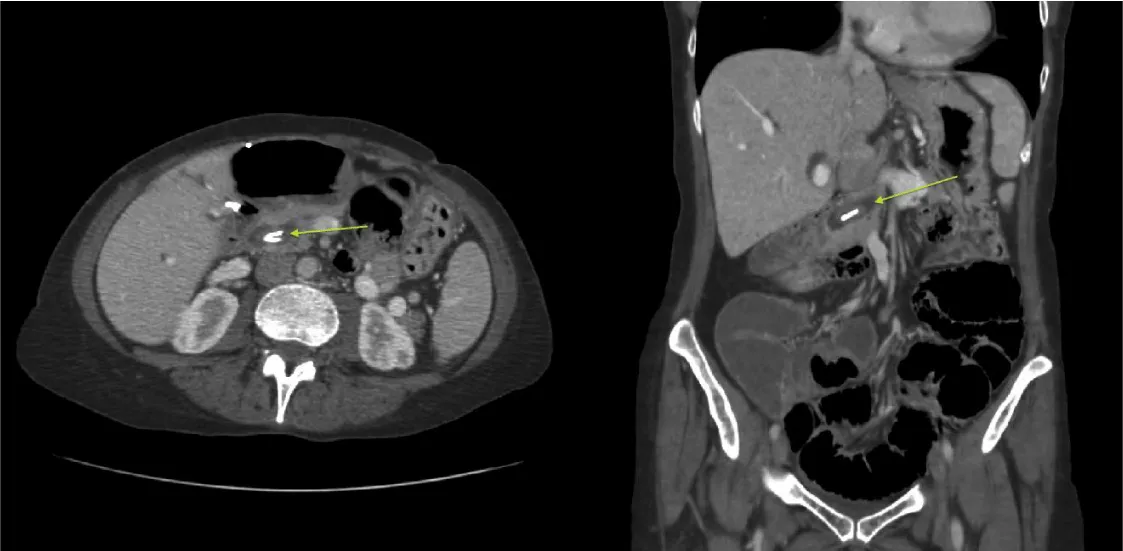
What is the diagnosis?
Answer: Post-Cholecystectomy Clip Migration with Gallstone Formation.
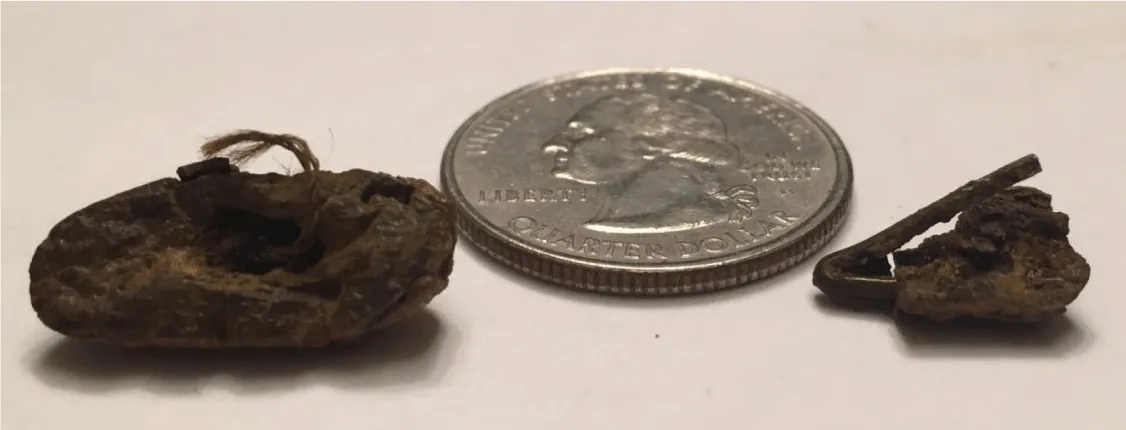
The patient was diagnosed with CBD obstruction from choledocholithiasis formed around a surgical clip nidus. Endoscopic Retrograde Cholangiopancreatography (ERCP) with sphincterotomy was performed and the CBD stone was extracted and all symptoms and laboratory abnormalities resolved (Figure 2). The stone was subsequently recovered from the patient’s ileostomy bag.
Discussion
This is the first case of symptomatic choledocholithiasis due to PCCM in a patient with inflammatory bowel disease where the stone was recovered from an ileostomy. Early complications of Laproscopic Cholecystectomy (LC) include hemorrhage, iatrogenic perforation of the gallbladder, CBD injury and iatrogenic bowel and vascular injuries [1]. Late complications involve intra-abdominal bile leakage, sub-hepatic abscesses, retained bile duct stones, post-cholecystectomy syndrome and bile duct stricture [2]. During LC, surgical hemostatic clips placed on the cystic duct and arteries are used to avoid cystic duct leakage and arterial bleeding. Rarely, Post-Cholecystectomy Clip Migration (PCCM) into the bile ducts occurs with stone formation around this clip leading to symptomatic choledocholithiasis or cholangitis.
Up to 80 cases of PCCM with biliary stone formation have been reported in the literature. Most cases occur in female patients with a median age of 60 years old [3]. The median time between the cholecystectomy and the development of clip migration with stone formation was 26 months. Most were successfully treated by ERCP3. No etiology or risk factors for PCCM have been identified.
Author contributions
Robert Battat MD: Manuscript creation, literature review, and photography.
Marilyse Drapeau: Manuscript creation, literature review.
Jonathan M. Wyse MD: Manuscript creation, literature review.
- Deziel DJ, Millikan KW, Economou SG, Doolas A, Ko ST, et al. (1993) Complications of laparoscopic cholecystectomy: a national survey of 4,292 hospitals and an analysis of 77,604 cases. Am J Surg 165: 9-14. Link: https://bit.ly/3qfIiKi
- Shamiyeh A, Wayand W (2004) Laparoscopic cholecystectomy: early and late complications and their treatment. Langenbecks Arch Surg 389: 164-171. Link: https://bit.ly/2VlcXYl
- Chong VH, Chong CF (2010) Biliary complications secondary to post-cholecystectomy clip migration: a review of 69 cases. J Gastrointest Surg 14: 688-696. Link: https://bit.ly/33u2mio


 Save to Mendeley
Article Alerts
Subscribe to our articles alerts and stay tuned.
 This work is licensed under a Creative Commons Attribution 4.0 International License.