Journal of Clinical Research and Ophthalmology
Optical Coherence Tomography for the Identification of a Rare Case of Keratoconus in Albino Donor Cornea
1International Centre for Ocular Physiopathology (ICOP), the Veneto Eye Bank Foundation Italy
2Eye department, Second University of Naples, Italy
Author and article information
Cite this as
Elbadawy HM, Ruzza A, Parekh M, Camposampiero D, De Rossi M, et al. (2015) Optical Coherence Tomography for the Identification of a Rare Case of Keratoconus in Albino Donor Cornea. J Clin Res Ophthalmol. 2015; 2(2): 28-29. Available from: 10.17352/2455-1414.000014
Copyright License
© 2015 Elbadawy HM, et al. This is an open-access article distributed under the terms of the Creative Commons Attribution License, which permits unrestricted use, distribution, and reproduction in any medium, provided the original author and source are credited.Keratoconus (KC) is a corneal ectatic disorder characterized by irregular corneal surface elevation, interruptions in the Bowman’s layer, stromal thinning and degeneration [1-3]. Irregular astigmatism and myopia can cause severe visual impairment. Oculocutaneous albinism (OCA) is a group of inherited disorders of melanin biosynthesis characterized by a generalized reduction in pigmentation of hair, skin and eyes. The inheritance pattern of albinism is autosomal recessive. Mutations in the tyrosinase [TYR] gene on chromosome 11 q14-q21 are reportedly common in most cases of OCA. The inheritance patterns of keratoconus are more complex than albinism due to the involvement of environmental factors in the incidence of KC. The most studied gene involved in KC is VSX1 gene, which is also involved in other corneal dystrophies [4]. Clinical manifestations of albinism include various degrees of congenital nystagmus, hypopigmentation and refractive errors, however, the association of albinism, keratoconus and corneal vascularisation were not reported previously.
Keratoconus (KC) is a corneal ectatic disorder characterized by irregular corneal surface elevation, interruptions in the Bowman's layer, stromal thinning and degeneration [1-3]. Irregular astigmatism and myopia can cause severe visual impairment. Oculocutaneous albinism (OCA) is a group of inherited disorders of melanin biosynthesis characterized by a generalized reduction in pigmentation of hair, skin and eyes. The inheritance pattern of albinism is autosomal recessive. Mutations in the tyrosinase [TYR] gene on chromosome 11 q14-q21 are reportedly common in most cases of OCA. The inheritance patterns of keratoconus are more complex than albinism due to the involvement of environmental factors in the incidence of KC. The most studied gene involved in KC is VSX1 gene, which is also involved in other corneal dystrophies [4]. Clinical manifestations of albinism include various degrees of congenital nystagmus, hypopigmentation and refractive errors, however, the association of albinism, keratoconus and corneal vascularisation were not reported previously.
Case Presentation
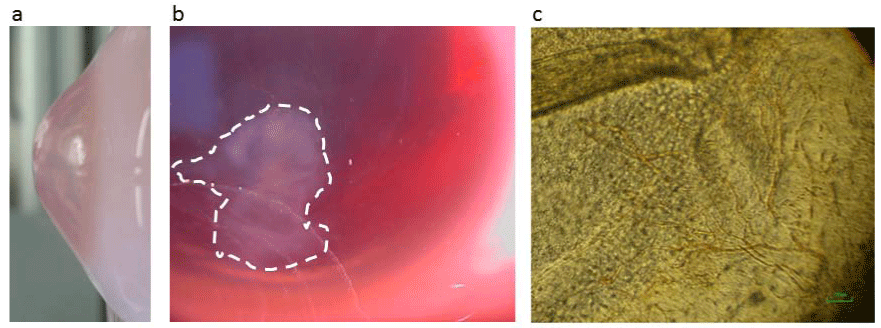
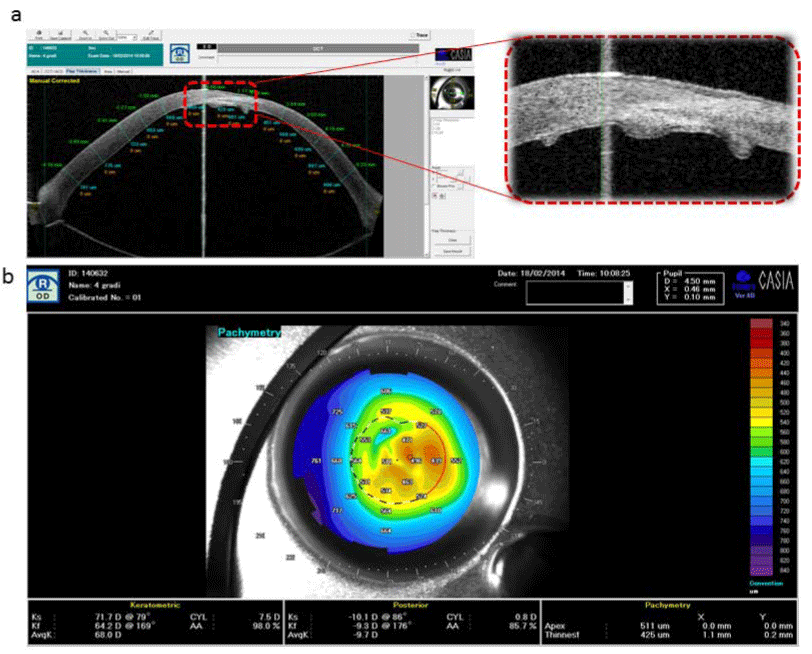
The corneas from a 61 years old albino donor were recovered by The Veneto Eye Bank Foundation, Italy. The donor had a history of positive hypercholesterolemia and hypertension, and silent for corneal disorders. The cause of death was myocardial infarction. The autopsy revealed cardiac hypertrophy, myocardial diffuse sclerosis, hypoxic myocardial damage, outbreak of lymphocytic infiltration between cardiac myocytes, in multivessel coronary atherosclerosis plaques with regional myocardial ischemia and coronary spasm with critical stenosis of the left anterior descending branch. Pulmonary congestion and haemorrhagic alveoli with sub-acutemultiorgan stasis were also evident.The patient was heterochromic with green right and blue left eyes. The deceased was pseudophakic with KC in both eyes (Figure 1a) and central leukoma (Figure 1b). Trypanblue® staining was positive in few areas of the epithelium and the stroma near the centre of the cornea. The cornea from the right eye was usedfor OCT scanning. An abrupt incline of the corneal surface near the centre and thinning of the central stroma was noted (Figure 2). Additionally, vascularisation was evident behind the stromal haze (Figure 1c). The endothelium had large wrinkles and the leukoma was concentrated in the thinnest area of the cornea.
Discussion
The association of albinism and KC was reported in a patient with bilateral KC associated with photophobia, positive family history for albinism and a history of frequent rubbing of the eyes [5], which has been put in relation with KC [6]. The locations of the TYR and VSX1 genes are on different chromosomes and hence are not expected to have common mutations, however, no association of VSX1 mutations with KC was found in a study performed on a large number of patients, hence, the genetic basis of KC requires further investigation [7]. The histopathology of albinism associated KC, shown here for the first time using OCT, can help diagnose and further understand the structural variations in diseased corneas. Additionally, it is shown here for the first time the association of KC and vascularization of the stroma, however, the genetic basis of this combination remains unknown. No information was found in the patient's history about any previous injury or trauma to the cornea.
- Rabinowitz YS (1998) Keratoconus. Surv ophthalmol42:297-319 .
- Chi HH, Katzin HM, Teng CC (1956) Histopathology of keratoconus. Am J Ophthalmol42:847-860 .
- Sherwin T, Brookes NH (2004) Morphological changes in keratoconus: pathology or pathogenesis. Clin Exp Ophthalmol 32: 211-217 .
- Héon E1, Greenberg A, Kopp KK, Rootman D, Vincent AL, et al. (2002) VSX1: a gene for posterior polymorphous dystrophy and keratoconus. Hum Mol Genet 11: 1029-1036 .
- Rao VA, Swathi P, Thappa DM (2008) Bilateral keratoconus with oculocutaneous albinism. Indian J Dermatol Venereol Leprol 74: 407-409 .
- Lindsay RG, Bruce AS, Gutteridge IF (2000) Keratoconus associated with continual eye rubbing due to punctal agenesis. Cornea 19: 567-569 .
- Aldave AJ, Yellore VS, Salem AK, Yoo GL, Rayner SA, et al. (2006) No VSX1 gene mutations associated with keratoconus. Invest Ophthalmol Vis Sci 47: 2820-2822 .



 Save to Mendeley
Article Alerts
Subscribe to our articles alerts and stay tuned.
 This work is licensed under a Creative Commons Attribution 4.0 International License.