Journal of Clinical Research and Ophthalmology
Exploring the Changes in Employment Psychology of College Graduates in the ‘Internet+’ Era —Taking Independent Colleges in Jiangsu Province as an Example
Tongda College, Nanjing University of Posts and Telecommunications, Yangzhou, Jiangsu 225127, China
Author and article information
Cite this as
Pingbo C. Exploring the Changes in Employment Psychology of College Graduates in the ‘Internet+’ Era —Taking Independent Colleges in Jiangsu Province as an Example. J Clin Res Ophthalmol. 2026; 13(1): 1-5. Available from: 10.17352/2455-1414.000111
Copyright License
© 2026 Pingbo C. This is an open-access article distributed under the terms of the Creative Commons Attribution License, which permits unrestricted use, distribution, and reproduction in any medium, provided the original author and source are credited.China's higher education has entered a stage of universalization. This is not only a quantitative change, but also a qualitative transformation in many aspects, including entry requirements, training models, social needs, teaching methods, and training objectives. Higher education needs to cultivate hundreds of millions of high-quality workers, tens of millions of specialized talents, and a large number of outstanding innovative talents. This diversification of objectives inevitably leads to a diversification of graduates' employment orientations and forms, thereby promoting a profound shift in their employment concepts. This article explores in depth how college graduates can better adapt to social needs, keep pace with the times, abandon traditional employment views, and establish correct employment perspectives.
Independent colleges are committed to cultivating application-oriented talents with profound professional knowledge, proficient application skills, and strong practical and innovative abilities. With the comprehensive transformation of higher education in terms of scale, concepts, and functions, the employment concepts of graduates from independent colleges are inevitably undergoing profound changes as well.
The shift from a "narrow" view of employment to a "broad" view of employment
Employment, also known as "labor employment," refers to the economic activities of people with labor capacity who engage in certain social labor and obtain remuneration or business income [1]. According to the general standards of international labor statistics and China's labor system and statistical methods, China's employed population includes employees working in state-owned and collectively-owned economic forms, agricultural laborers, and laborers engaged in individual business in urban and rural areas and other economic forms. For example, as of the end of 2021, the number of employed persons nationwide reached 746.52 million, of which 467.73 million were urban employees. For graduates of independent colleges, as long as they meet the employment conditions, whether they work in state-owned units, collectively-owned units, foreign-funded enterprises, private enterprises, or engage in individual business; whether the work location is in rural areas, towns, cities or abroad; whether they are engaged in fixed or temporary occupations; whether they work in existing positions or self-created positions, they are considered employed.
With socio-economic development and changing employment concepts, traditional employment views are being broken down. Now, more and more people realize that employment is not limited to entering government agencies or obtaining a "secure job," but includes various forms such as flexible employment, remote work, and freelance work. Furthermore, grassroots work and emerging professions are gradually gaining social recognition and becoming important components of employment. Many college graduates tend to pursue jobs in big cities, large companies, with high incomes, high status, and office work. With the popularization of higher education, the number of college graduates has increased significantly, from 7.49 million in 2015 to 12.22 million in 2025, gradually weakening their market advantage. Society's demand for talent is shifting from highly educated to highly skilled and qualified individuals, with emerging industries such as artificial intelligence and new energy leading in salaries, while demand for traditional engineering fields is shrinking. At the same time, employment structure, industry preferences, and geographical flow are all showing significant changes, with emerging industries increasing their absorption capacity and highlighting structural contradictions. Meanwhile, phenomena such as China's industrial restructuring, streamlining of government agencies and public institutions, reduction of staff, and efficiency improvement in state-owned enterprises, and the transfer of rural labor to cities have reduced the ability of social institutions to absorb employees. Faced with the new employment landscape, university graduates need to abandon narrow-minded employment concepts and establish a broader perspective on employment. This broader perspective considers employment as any job, whether working in a state-owned or non-state-owned enterprise, or pursuing self-employment, becoming a live streamer, or writing online, as long as a stable income is earned. University graduates should diversify their employment choices, not limiting themselves to a single occupation, and be open to holding multiple jobs; income levels should be acceptable regardless of location; work location should not be restricted by urban or rural areas; and regarding job stability, they can pursue long-term stable employment or try short-term or flexible work. This broader perspective on employment will greatly expand the employment opportunities for graduates.
The shift from a "one-time choice determines your life" to a dynamic, lifelong career perspective
Traditional employment views hold that once you graduate from university, you should find a stable job and make a career choice that determines your future until retirement. However, under market economy conditions, the survival and development of enterprises are full of risks. Enterprise bankruptcy, layoffs, economic downturns, and the competition and elimination of the new labor force are common occurrences, which directly lead to some workers losing their jobs. Although university graduates have the advantage of professional knowledge, the current uneven distribution of talent, coupled with the impact of the financial crisis, as well as unreasonable employment concepts of graduates, mismatch between majors and jobs, lack of practical experience, etc., has led to the severity of the employment situation. Even if they have found employment, they cannot be sure that they will not be eliminated or will not stay in one position for life. Therefore, graduates need to abandon the career choice view of "one choice determines your future" and establish a dynamic "lifelong" career choice view [2].
During the popularization of higher education, the social economy is relatively developed, and occupational mobility is frequent. Two-way selection, independent job selection, and occupational mobility are increasingly recognized. This enables job seekers to flexibly switch between different departments based on their personal interests, skills, knowledge level, and social needs, creating favorable conditions for them to fully display their talents and thus achieve their all-around development. Therefore, the career view of "one choice determines your life" is gradually being replaced by a dynamic "lifelong" career view. Graduates should establish the correct employment view of "getting a job first, then choosing a career, and then starting a business [3-5].
A shift in mindset from "choosing a job" to "creating a job."
Developing entrepreneurship education has become a mainstream trend in higher education worldwide and is also an inevitable path for the reform and development of higher education in China. As early as October 1998, UNESCO emphasized at the World Conference on Higher Education in Paris that graduates should no longer be job seekers, but should first and foremost become job creators [6]. During the 2024 Forum on China-Africa Cooperation Summit, the China-Africa-UNESCO Dialogue on Cooperation in Education and Cultural Heritage Protection once again advocated that young people should not only seek employment but also start businesses, thereby driving employment through entrepreneurship [7].
University students are a vibrant and creative group, and should be a positive force in creating jobs. However, according to the latest data, among university graduates in 2024, 57.6% chose employment, while only 0.7% chose entrepreneurship. This indicates that university graduates are more inclined to "choose jobs" than "create jobs." This phenomenon is related to the lack of entrepreneurship education in university education. For a long time, university education has focused on guiding students in job hunting, while relatively neglecting to cultivate their ability to create jobs. Independent colleges should strengthen the cultivation of entrepreneurial awareness among their students, relying on a standardized entrepreneurship education system to effectively improve the success rate of students' independent entrepreneurship. To ensure the effectiveness of entrepreneurship education, the professionalization of the entrepreneurship education faculty is an indispensable support. Currently, most universities have not fully realized the importance of this issue and therefore have not put it on the agenda. Independent colleges should rationally plan and proportionally introduce or hire professionals in fields such as engineering technology and scientific research, business management, law, corporate operations, and sociology to build a well-structured entrepreneurship education faculty.
The lack of independent entrepreneurship among college students is also related to the social atmosphere that encourages entrepreneurship and the effective institutional incentives. For example, South Korea actively guides college students to start businesses by formulating various entrepreneurship incentive measures, which has set off a high tide of college student entrepreneurship [8,9]. It is gratifying that most universities in China have also launched entrepreneurship plans and received strong support from government departments. As early as June 2000, Chengdu University of Technology established the first entrepreneurship association in western China; in 2002, the Entrepreneurship Management Training Institute of Beijing University of Aeronautics and Astronautics was officially established; the series of entrepreneurship education training at Fudan University officially started in April 2004; Jiangsu University carried out innovation lectures and entrepreneurship planning training through the College Student Entrepreneurship School; and Shanghai Jiaotong University established the "Female College Student Entrepreneurship Training Camp". These measures show that entrepreneurship education has entered the university campus. The Ministry of Education affirms the entrepreneurial behavior of college students and has introduced a number of policies, including loans, subsidies, and tax incentives, to promote and encourage college graduates to start their own businesses [6]. The Ministry of Human Resources and Social Security and other ministries have also successively introduced relevant policies to remove policy obstacles for college students to start businesses. For example, the national support policies for college students starting their own businesses include a 100,000 yuan "loan-exemption-support-subsidy" micro-loan for first-time entrepreneurs, with a loan term of 2 years [1]. In addition, college student entrepreneurs who have successfully started their first business under the "loan-exemption-support-subsidy" policy and have been stable for more than 1 year, and who have created jobs and signed labor contracts, will be given a one-time entrepreneurial subsidy [1]. The Hunan Provincial Department of Education has also formulated "Several Measures to Support College Students' Entrepreneurship" to stimulate the entrepreneurial enthusiasm of universities, teachers, and college students [3]. The Ministry of Finance and the National Development and Reform Commission have introduced a number of preferential policies for college graduates to engage in individual business, including tax reduction and exemption, entrepreneurial loan support, and entrepreneurial subsidies, which aim to encourage and support college graduates to start their own businesses. Local governments from major cities such as Beijing, Shanghai, and Nanjing to the central and western regions and the Northeast have actively created a good environment and made every effort to support college students' entrepreneurship.
Graduates from universities such as Stanford University have brought vitality to Silicon Valley through entrepreneurship, and at the same time, provided a solution to the employment problem of graduates in the massification of higher education [10].
Abandon seven unhealthy employment mindsets
- The mentality of keeping up with the Joneses: When choosing a workplace, graduates of independent colleges often use the job selection standards of their classmates as a benchmark for their own employment. Influenced by a competitive mentality, even if a particular company is very suitable for their personal development, they may hesitate to give it up because it is not as good as the company chosen by their classmates in some aspect, and often regret it afterward.
- The mentality of blindly pursuing high standards: Some college students focus solely on their own career aspirations, demanding perfection from employers. Salary, benefits, housing, location, and work environment are all considered, while neglecting whether they themselves meet the employer's requirements. Because they fail to assess their own abilities and blindly pursue high standards, many college students ultimately miss out on suitable job opportunities.
- Imbalanced psychology: Some college graduates, due to insufficient skills or poor opportunities, struggle to find their ideal jobs, often blaming external factors and complaining bitterly. This imbalance often leads a minority of college graduates to develop biased views of society and life.
- Inferiority complex: In the fiercely competitive job market, some college students develop strong feelings of inferiority due to the unpopularity of their majors, their inferiority in professional knowledge, skills, and overall qualities compared to their classmates, or repeated setbacks in job hunting. This inferiority complex can even develop into a psychological deficiency. Such students often lack self-confidence and find it difficult to bravely showcase their strengths to employers, which seriously hinders their employment and career choices.
- Arrogance: Conversely, some recent graduates, due to factors such as a popular major, a prestigious university background, outstanding talent, or being favored by employers, develop an extreme sense of arrogance and disdain for others. Driven by this mentality, they often "look to the grass for the trees," finding one company unsatisfactory and another undesirable, thus missing out on many suitable opportunities for their development.
- Dependency mentality: Although some recent graduates have undergone four years of university training, they still lack the necessary analytical and decision-making abilities in many matters. When choosing a job, they often do not rely on their own judgment to decide whether a unit is suitable, but listen more to the opinions of their parents, teachers, and senior students, showing a strong dependence. This mentality reflects the lack of subjective consciousness in career choices among contemporary youth, and excessive reliance on external evaluation systems can easily lead to a disconnect between career positioning and social needs. The survey shows that among the graduates of independent colleges in Jiangsu Province in 2023, 62.3% of their job search decisions were dominated by family opinions, of which 27.6% eventually engaged in work that did not match their personal career interests [9].
- Conformity: Some graduates exhibit a clear herding effect in their career choices. The 2023 Jiangsu Province Independent Colleges Employment Quality Report shows that 38.7% of respondents admitted that "their choice of current position was mainly influenced by the signing of contracts with their classmates." This mentality leads to graduates flocking to popular industries, intensifying employment competition in fields such as education and finance, while fields such as intelligent manufacturing and modern agriculture face talent shortages. In response to this situation, universities should establish an industry dynamic early warning system, use employment information platforms to push out talent demand maps of emerging industries in real time, and use virtual reality technology to conduct immersive career experiences to help students break through information cocoons [11].
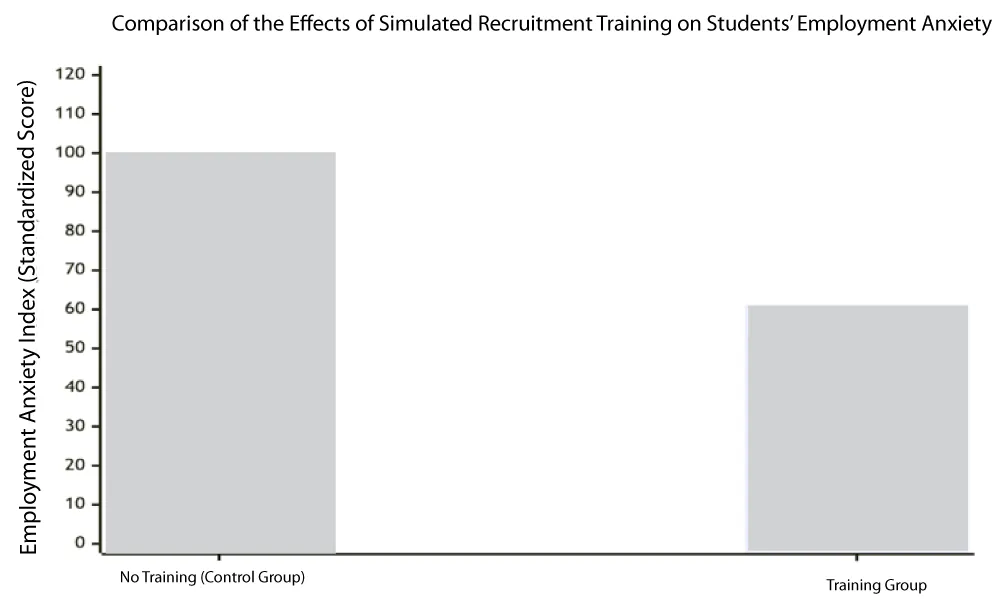
To address the aforementioned misconceptions about employment psychology, independent colleges should construct a three-pronged psychological adjustment mechanism encompassing cognition, practice, and feedback. First, at the cognitive level, courses such as "Occupational Psychology" and "Employment Decision Analysis" should be offered, utilizing tools like the MBTI personality test and the Holland Career Interest Assessment to help students build a scientific self-awareness. Second, at the practical level, experiential learning methods such as "career role simulation" and "stress interview workshops" should be implemented, organizing students to participate in real corporate recruitment processes. Simulated recruitment training, by providing simulations of actual recruitment scenarios, helps students improve their internship experience and social practice skills, as well as the relevance of their major to the job, thereby effectively reducing students' employment anxiety index. According to relevant research, the employment anxiety index of students participating in this type of training decreased by 38.9% compared to the control group (Figure 1). Finally, at the feedback level, a graduate psychological profile tracking system should be established, utilizing big data technology to analyze the evolution trends of employment psychological problems over the years, thereby dynamically adjusting educational strategies to better meet students' mental health needs. It is worth noting that the “psychological mentor system” implemented by an independent college in Nanjing has achieved remarkable results. Through the collaborative work of professional psychological counselors and counselors, the psychological pressure of employment for the 2023 graduates has been effectively alleviated, and the incidence of employment-related psychological distress has decreased by 45% year-on-year [12].
From the perspective of social support systems, the government, enterprises, and families should work together to cultivate talent. The labor department can improve the employment psychological assistance system and embed AI psychological assessment modules into the "smart employment" platform; employers should increase the transparency of the recruitment process to reduce anxiety caused by information asymmetry; parents need to change their traditional employment concepts and avoid imposing their own career expectations on their children. When the whole society forms an inclusive and diverse employment ecosystem, college graduates can truly achieve a qualitative change from "psychological breakthrough" to "career breakthrough" [13].
To deepen the construction of psychological adjustment mechanisms, it is recommended to build a "four-dimensional linkage" intervention model: First, in the curriculum dimension, develop a digital course package of "Positive Employment Psychology," integrating diverse teaching resources such as micro-lessons, scenario dramas, and interactive assessments; second, in the technology dimension, introduce intelligent devices such as eye-tracking and biofeedback to accurately identify the physiological manifestations of job-seeking anxiety; third, in the spatial dimension, create an "Employment Psychological Resilience Training Center," setting up functional areas such as stress interview chambers and career setback simulation rooms; fourth, in the evaluation dimension, establish psychological capital appreciation archives, using blockchain technology to record the entire process of students from cognitive adjustment to behavioral improvement. After piloting this model at an independent college in Nanjing, the mental health of the 2024 graduates significantly improved, with the psychological assessment pass rate increasing by 22.5 percentage points year-on-year. At the same time, the college's employment agreement breach rate also decreased to 4.3%, an achievement consistent with the positive trend reflected in the current annual report on the quality of college graduate employment.
In addition, attention should be paid to new employment psychological problems arising in the post-pandemic era. According to the World Health Organization’s Global Mental Health Report, cases of anxiety caused by perfectionism have increased by 217% in the past decade. Against this backdrop, a cross-national study by Harvard University and Cambridge University showed that the popularization of hybrid work models has led to 27% of recent graduates developing “digital social phobia, manifested as symptoms such as video interview adaptation disorder and remote collaboration anxiety. This requires college employment guidance departments to upgrade their service supply, develop virtual simulation interview systems, and build metaverse professional social platforms to help students complete the transfer of employment skills from physical space to digital space. The practice of the Suzhou Industrial Park Cross-border Digital Talent Incubation Base shows that graduates who have undergone 8 weeks of digital adaptation training have a 41.2% higher remote work efficiency than those who have not been trained [12].
In recent years, the employment promotion policies for college graduates have been more inclined towards recent graduates. At present, some employment policies have been extended to previous graduates, and college graduates who have not found employment within two years of graduation have also been included. However, the employment pressure on college students still exists, and there is still room for further relaxation of policies, especially in terms of the number of years to enjoy preferential policies. It is possible to consider extending the number of years of college students who have graduated within two years to four or five years, or even without any time limit, to provide college students with employment difficulties and college students who are willing to take a gap year with the same employment policy support as recent graduates. Employment is affected by economic and social development. To effectively alleviate the employment difficulties of college graduates, it is necessary not only to solve the problems of youth employment difficulties and high unemployment rates, but also to implement comprehensive, systematic, and integrated policies, implement an economic development strategy that promotes high employment rates under moderate growth, and form a policy orientation that prioritizes employment. In response to the current phenomenon of rapid growth in youth unemployment, although short-term economic policies and employment promotion measures can achieve certain results, they cannot fundamentally solve the problem. The youth unemployment problem is the result of the combined effects of various economic and social factors in China. Therefore, it is necessary not only to strengthen employment education but also to formulate long-term and stable youth employment promotion policies [6,11].
Conclusion
After four years of scientific and systematic education on employment and career choices, graduates of independent colleges can develop correct employment and career awareness, clarify their initial career direction, make reasonable plans, establish a phased employment concept, and recognize that their ideal position needs to be achieved gradually from low to high levels, rather than all at once. According to a survey report on the employment concepts of independent college graduates, establishing a correct employment concept is crucial for independent college graduates to successfully find suitable jobs.
- Sheng X. In-depth thinking on constructing a psychological health education system in colleges and universities. Journal of Wuhan University of Technology (Social Sciences Edition). 2005;(05):17–21:36.
- Liu Y. Reflections on the current unemployment situation in China and the new employment concepts of contemporary college students. Journal of Harbin University of Commerce (Social Sciences Edition). 2006;(05).
- How to do a good job in ideological and political education during the college students’ employment process. Political Work Research Trends. 2009;(04).
- Zhai C. Research on the employment difficulties and policy paths of youth groups. Journal of Liaoning Academy of Administration. 2011;(12):188–189,192.
- Ministry of Education of the People’s Republic of China. Opinions on vigorously promoting innovation and entrepreneurship education in higher education institutions and the work of college students’ independent entrepreneurship (Ministry of Education Office [2010] No. 3). Beijing: General Office of the Ministry of Education; 2010 May 4.
- MyCOS Research Institute. China college graduates employment report (2023). Beijing: Social Sciences Academic Press; 2023;87–95.
- Li X, et al. Fundamentals of entrepreneurship for college students. 3rd ed. Beijing: Tsinghua University Press; 2022;56–78.
- Jiangsu Provincial Department of Education. Annual report on the employment quality of graduates of independent colleges in Jiangsu Province (2022). Nanjing: Jiangsu Higher Education Press; 2022.
- China Academy of Information and Communications Technology. White paper on digital economy development and employment (2023) [Internet]. 2023 Apr 28 [cited 2023 Nov 30].
- Wang T, et al. Research on flexible employment of young people in the digital economy era. Chinese Youth Studies. 2022;(12):45–52.
- Ministry of Human Resources and Social Security. Policy service guide for employment and entrepreneurship of college graduates [Internet]. 2023 Jun 15 [cited 2023 Dec 1].
- Global Entrepreneurship Watch. Global entrepreneurship watch report 2022–2023. Stanford (CA): Center for Entrepreneurship Studies, Stanford University; 2023.
- Jiangsu Provincial University Student Entrepreneurship Park Alliance. Compilation of practice cases of innovation and entrepreneurship education in independent colleges. Nanjing: Jiangsu Education Press. 2022;63–79.


 Save to Mendeley
Article Alerts
Subscribe to our articles alerts and stay tuned.
 This work is licensed under a Creative Commons Attribution 4.0 International License.