Imaging Journal of Clinical and Medical Sciences
Peritoneal Pseudocyst - A Complication of Lumbo Peritoneal Shunt Surgery
1MBBS, Ras Al Khaimah Medical and Health Sciences University, Ras Al Khaimah, United Arab Emirates
2Saqr Hospital, Ras Al Khaimah, United Arab Emirates
Author and article information
Cite this as
Kumar Shil RS, Al Yousef EMK (2016) Peritoneal Pseudocyst - A Complication of Lumbo Peritoneal Shunt Surgery. Imaging J Clin Medical Sci. 2016; 3(1): 10-11. Available from: 10.17352/2455-8702.000027
Copyright License
© 2016 Kumar Shil RS, et al. This is an open-access article distributed under the terms of the Creative Commons Attribution License, which permits unrestricted use, distribution, and reproduction in any medium, provided the original author and source are credited.Placement of a ventriculoperitoneal shunt is an established procedure for treatment of hydrocephalus, however, complications can occur. The most common causes of shunt malfunction are catheter obstruction and infection. The incidence of Ventriculoperitoneal shunt related abdominal complications has been reported to be from 5% to 47% [1]. The most common distal ventriculoperitoneal shunt complications include shunt infection, subcutaneous collection of CSF, peritoneal pseudocyst, bowel perforation, intestinal volvulus, mesenteric pseudotumor, migration of the catheter into the pleural cavity and heart, and development of an incision hernia [2].
Placement of a ventriculoperitoneal shunt is an established procedure for treatment of hydrocephalus, however, complications can occur. The most common causes of shunt malfunction are catheter obstruction and infection. The incidence of Ventriculoperitoneal shunt related abdominal complications has been reported to be from 5% to 47% [1]. The most common distal ventriculoperitoneal shunt complications include shunt infection, subcutaneous collection of CSF, peritoneal pseudocyst, bowel perforation, intestinal volvulus, mesenteric pseudotumor, migration of the catheter into the pleural cavity and heart, and development of an incision hernia [2].
Case Description
A 5 year old girl, known case of congenital hydrocephalus, who underwent shunt surgery in the form of lumbo-peritoneal shunt, presented with headache, dizziness and fever for 1 week duration.
Plain abdominal CT scan showed collection of fluid around the peritoneal end of the shunt, a peritoneal pseudocyst measuring around 4.9x4.7 cm2 in the coronal view and 5.7x4.5 cm2 in horizontal view, both views measured at the image slices showing maximum diameters of the pseudocyst (Figure 1).
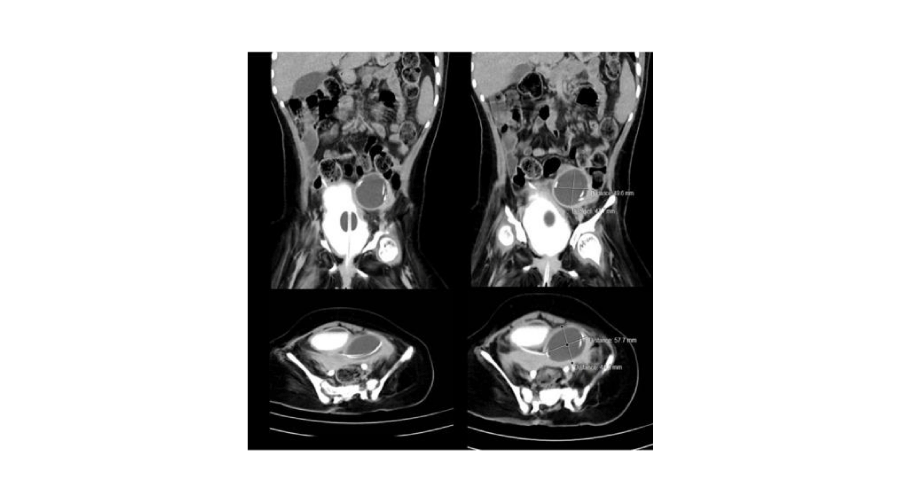
Shunt opening showed malfunction in the drainage and culture swab revealed growth of staphylococcus epidermitis organism. Plain brain CT scan showed evidence of hydrocephalus.
Patient was treated with immediate removal of shunt and parenteral antibiotics until the infection is cleared, followed by reinsertion of the shunt on the opposite side from the previous one due to adhesions formed at the previous site.
Shunt placement to heart was not considered because the patient had operated congenital heart problems. Repeat CT on follow-up in Neurosurgical OPD, showed resolving of the old pseudocyst collection and the distal end of the repeat shunt was in proper position without development of any more pseudocysts or abscess collections, with significant improvement of the patient’s clinical condition.
Conclusion
Peritoneal CSF pseudocysts are a rare but important complication of VP shunt surgery, with a reported incidence ranges from less than 1.0% to 4.5%. Most of the reported cases are of pediatric age group or early adolescence [3].
Acknowledgement
The authors would like to thank Dr. Abdulla Al Abassi, Consultant General Surgeon at Saqr Hospital, Ras Al Khaimah, U.A.E, for his invaluable contributions and tireless efforts to complete the study successfully.
- Esposito C, Porreca A, Gangemi M, et al. The use of laparoscopy in the diagnosis and treatment of abdominal complications of ventriculoperitoneal shunts in children. Pediatr Surg Int. 1998;13:352–354.
- Chung Jae-Joon, Yu Jeong-Sik, Kim Joo Hee, Nam Se Jin, 1, Kim Myeong-Jin. Intraabdominal Complications Secondary to Ventriculoperitoneal Shunts: CT Findings and Review of the Literature. J AJR.2009 Nov;193(5):1311–1317.
- Pathi Ramon, Sage Michael, Slavotinek John, Hanieh Ahmad. Abdominal cerebrospinal fluid pseudocyst.Australasian Radiology. 2004;48:61–63.



 Save to Mendeley
Article Alerts
Subscribe to our articles alerts and stay tuned.
 This work is licensed under a Creative Commons Attribution 4.0 International License.