Imaging Journal of Clinical and Medical Sciences
Scrotal Mass
1University of Balamand, Saint Georges University Medical Center, Beirut, Lebanon
2Lebanese University, Beirut, Lebanon
Author and article information
Cite this as
Patrick ER, Said F (2014) Scrotal Mass. Imaging J Clin Medical Sci. 2014; 1(2): 17-17. Available from: 10.17352/2455-8702.000011
Copyright License
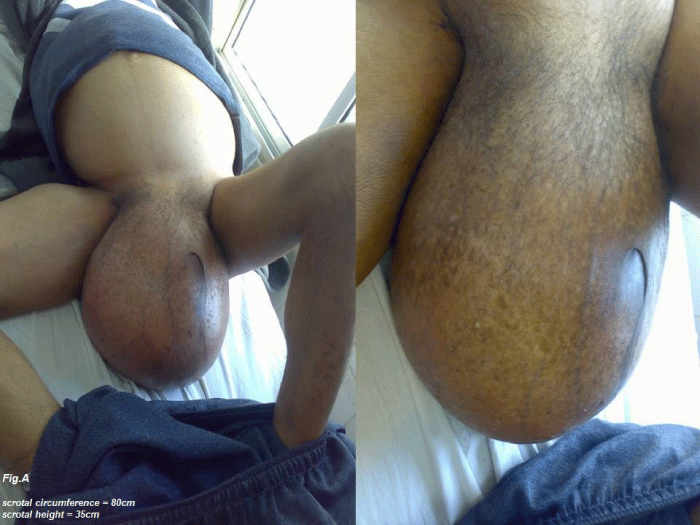
© 2014 Patrick ER, et al. This is an open-access article distributed under the terms of the Creative Commons Attribution License, which permits unrestricted use, distribution, and reproduction in any medium, provided the original author and source are credited.A 45-year-old man presented to the emergency room with abdominal pain and distention, dyspnea and a scrotal mass with absence of a visible penis as shown in the figure 1 below.
Abdominal circumference was 120 cm, scrotum circumference was 80 cm and the height of the scrotum was 35 cm. There were no signs of acute abdomen and preliminary routine laboratory labs were within normal except for minimally elevated transaminase levels.
Physical examination showed that the patient has ascites along with a compressible painful scrotum and he is known to have Hepatitis C. There were no signs of acute gastrointestinal bleeding or encephalopathy.
A 45-year-old man presented to the emergency room with abdominal pain and distention, dyspnea and a scrotal mass with absence of a visible penis as shown in the figure 1 below.
Abdominal circumference was 120 cm, scrotum circumference was 80 cm and the height of the scrotum was 35 cm. There were no signs of acute abdomen and preliminary routine laboratory labs were within normal except for minimally elevated transaminase levels.
Physical examination showed that the patient has ascites along with a compressible painful scrotum and he is known to have Hepatitis C. There were no signs of acute gastrointestinal bleeding or encephalopathy.
CT scan of the abdomen showed significant amount of free peritoneal fluid and a patent renal and splenic vein. EGD showed grade 3 esophageal varices.
Aspiration of the fluid was done and cytology showed SAAG>1.1 and did not reveal the presence of malignant cells. TSH and α-FP were negative.
The diagnosis was an abdominal ascites with an inguinal hernia. The presences of the hernia lead to the progressive enlargement of the scrotal sac, which was filled with fluid and intestines in this case. A splenorenal shunt and a repair of the hernia were done and the patient was discharged on the 4th post operative day.



 Save to Mendeley
Article Alerts
Subscribe to our articles alerts and stay tuned.
 This work is licensed under a Creative Commons Attribution 4.0 International License.