Imaging Journal of Clinical and Medical Sciences
Target (Iris) Lesions of Erythema Multiforme
Dr HU Rehman, Clinical Associate Professor, Department of Medicine, Regina Qu'Appelle Health Region, Regina General Hospital, 1440 – 14th Avenue, Regina, SK, S4P 0W5, Canada
Author and article information
Cite this as
Surtie F, Rehman HU, FRCPC, FRCPI, FRCP (Glass) Target (Iris) Lesions of Erythema Multiforme. Imaging J Clin Medical Sci. 2014; 1(2): 12-12. Available from: 10.17352/2455-8702.000008
Copyright License
© 2014 Surtie F, et al. This is an open-access article distributed under the terms of the Creative Commons Attribution License, which permits unrestricted use, distribution, and reproduction in any medium, provided the original author and source are credited.A 21-month old age girl presented with asymptomatic lesions on her right arm of 4 days duration. She denied sore throat, fever and cough and no lesions were found anywhere else including buccal mucosa. She had not taken any medications recently.
A 21-month old age girl presented with asymptomatic lesions on her right arm of 4 days duration. She denied sore throat, fever and cough and no lesions were found anywhere else including buccal mucosa. She had not taken any medications recently.
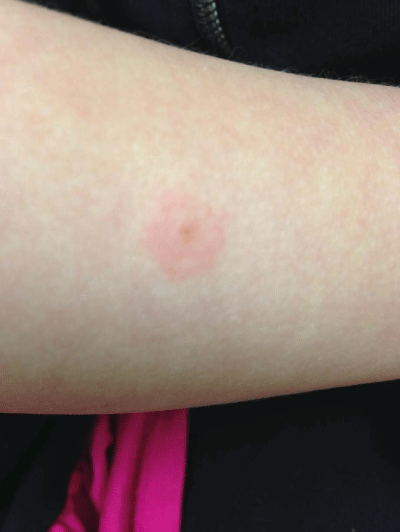
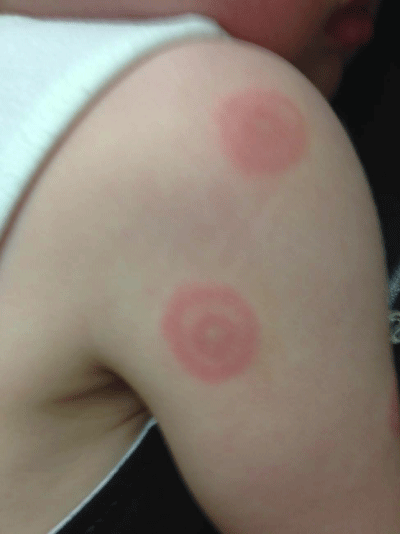
Q 1: What is the diagnosis?
A: Sharply demarcated, round, red/pink macules target lesions of Erythema Multiforme. The typical target (iris) lesion of EM has a sharp margin, round shape and concentric colour zones.
Q 2: What triggers it?
A 2: Erythema multiforme (EM) is a hypersensitivity reaction usually triggered by infections and drugs. Herpes simplex is the most common triggering infection. It is self-limiting and resolves without complications. Many drugs have been implicated, most common being barbiturates, non-steroidal anti-inflammatory drugs, penicillins, sulphonamides, phenothiazines and anticonvulsants.

 Save to Mendeley
Article Alerts
Subscribe to our articles alerts and stay tuned.
 This work is licensed under a Creative Commons Attribution 4.0 International License.