Global Journal of Anesthesiology
Recovery of Post Thyroidectomy Aphonia with Peri Recurrent Laryngeal Nerve Injection of Meloxicam
1Department of Biomedical and Neuromotor Sciences, Research Unit of Anaesthesia and
Intensive Care, Rizzoli Orthopaedic Institute, University of Bologna, Italy
2Department of Surgery and Anesthesiology Sciences, Research Unit of Anasthesia and
Intensive Care, Rizzoli Orthopedic Institute, University of Bologna, Italy
3A.O.R.N of A.Cardarelli of Naples Italy, Gynecological Laparoscopic Surgery, Naples,
Italy
4Department of Biomedical and Neuromotor Sciences, Rizzoli Orthopedic Institute, University
of Bologna, Italy
Author and article information
Cite this as
Borghi B, Safi A, Santangelo C, Borghi R (2015) Recovery of Post Thyroidectomy Aphonia with Peri Recurrent Laryngeal Nerve Injection of Meloxicam. Glob J Anesth. 2015; 2(1): 19-21. Available from: 10.17352/2455-3476.000011
Copyright License
© 2015 Borghi B, et al. This is an open-access article distributed under the terms of the Creative Commons Attribution License, which permits unrestricted use, distribution, and reproduction in any medium, provided the original author and source are credited.Objectives: The aim of this study was to assess the effect of perineural injection of meloxicam on the recovery of vocal cord paresis due to recurrent nerve injury after thyroid surgery. A secondary objective was listed the neural inflammation as possible risk factor for delayed recovery of vocal cord paresis.
Methods: 47 years old female, two months after thyroid surgery still complaining of aphonia and dyspnea, due to vocal cord paresis bilaterally, bilaterally injection with 7.5mg of meloxicam was done for peri neural recurrent laryngeal nerve aiming to assess the effect of meloxicam on functional recovery of vocal cord.
Results: A significant improvement in the basic function of vocal cord was noticed immediately after perineural injection of meloxicam bilaterally for recurrent laryngeal nerves injury post thyroidectomy.
Conclusions: Perineural injection of meloxicam appears to be a noval and potentially promising therapeutic option for patients with vocal cord paresis due to transient recurrent laryngeal nerve injury. Further clinical studies are necessary to determine the optimal use of this approach for treatment for both acute and chronic bases.
Neural inflammation of recurrent laryngeal nerve could be possible cause of vocal cord paresis and delayed functional recovery.
Vocal cord paresis or paralysis due to iatrogenic injury of the recurrent laryngeal nerve is one of the main problems in thyroid surgery. Although many procedures have been introduced to prevent the nerve injury, still the incidence of recurrent laryngeal nerve palsy varies between 1.5-14% [1]-[1],[1],[4].
The aim of this study was to assess the effect of meloxicam injection on the recovery of vocal cord paresis due to recurrent nerve injury after thyroid surgery, and neural inflammation as possible factor for delayed recovery.
Materials and Methods
With local ethical committee approval for peri neural injection of meloxicam, and informed consent, 47 years old female, 60 kg weight 163 cm height, presented two months after thyroid surgery complaining from aphonia, dyspnea, sleep disturbance due to breathing suffocation, patient on oxygen therapy through nasal cannula during night sleep.
The patient was submitted to total thyroidectomy and the intervention did not present any particular difficulties, was carried out by an experienced specialist surgeon.
Patient had no previous other medical illnesses, her overall post-surgical recovery was prompt and smooth and parathyroid hormone and serum calcium phosphate have always had normal values.
Histological examination of the excised piece was: cystic colloid goiter.
Unfortunately, the speech was presented immediately but strongly altered on the second day with hoarseness and low pitch phonation, laryngoscopy was performed which showed paresis of the vocal cords in semi abduction bilaterally (middle position).
After fifteen days following surgery: aphonia and severe dyspnea manifested, also choking with a spontaneous recovery, triage night.
ENT specialist confirm by Laryngoscopy the vocal cord were fixed in paramedian position and recommend for monthly follow-up and the need of speech therapy twice weekly. Also the need for apnea controlled and use for Oxygen therapy at night.
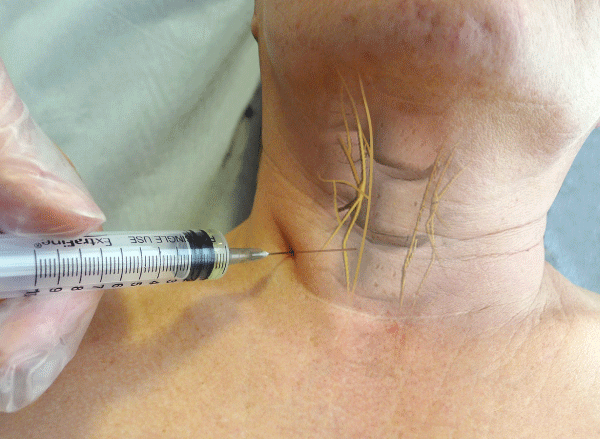
Patient presented to us after 40 days of aphonia and dyspnea seeking for help, we consider injections of 7.5 mg of meloxicam peri recurrent laryngeal nerve bilaterally anterior to sternocleidomastoid muscles at the level of 1.5 cm depth, using 27G needle (19mm) (Figure 1).
Results
Immediately after the injections, the patient was able to tell her first name and a progressive improvement in the basic function of vocal cord was notice later, in which the patient can speak with clear hearable sound, and with improvement of dyspnea symptom. Total improvement in sound was noticed after 6 hours of the injection, with disappearance of her dyspnea symptoms.
We follow up the patient twice weekly keeping up same improvement in sound and breathing. Laryngoscopy normal vocal cord position and function.
Discussion
Mechanisms of injury to the nerve include complete or partial transection, traction, or handling of the nerve, contusion, crush, burn, clamping, misplaced ligature, and compromised blood supply [1],[9]. In unilateral recurrent laryngeal nerve injury the voice becomes husky because the vocal cords do not approximate with one another. Dysphonia starting on the 2nd – 5th post-operative days is commonly due to edema, whereas traction injury of the nerve and damage of axons may result in dysphonia lasting up to 6 months. Dysphonia continuing after 6 months is commonly permanent caused by cutting, ligating or cauterization of the nerve [1],[12].
Bilateral vocal cord paralysis is a serious illness requiring emergency intervention to resolve the potentially life-threatening respiratory distress. Several surgical procedures were proposed to help improve the airway and to eliminate the tracheostoma in those patients with permanent paralysis [14].
Many excellent studies about vocal cord paresis were concerns regarded the improvement of phonation of vocal cord by methods related to vocal cords contour and position.
Such studies, injection laryngoplasty with hyaluronic acid gel which is a relatively safe procedure that allows for short-term improvements in objective and subjective outcome measures of vocal function in patients with glottic insufficiency, provided the surgeon remains alert to the possibility of postprocedural injection site inflammation [[16].
Endoscopic coblation assisted arytenoidectomy is a new surgical method for the treatment of patients with bilateral vocal cord paralysis, which is efficient, minimally invasive and safe [17].
Laryngeal reinnervation by anza cervicalis is an effective treatment for laryngeal paralysis related to operations on the thyroid gland and laryngeal function can be improve to almost normal of the spoken voice parameters and the basic functions of the larynx [[20], we consider meloxicam therapy trial.
The resolution of aphonia and dyspnea symptoms, and the significant and immediate improvement and return of vocal cord function suggests the potential benefit of this minimally-invasive therapy using meloxicam with possible treatment and end of the suffering of many patients with same complain, instead of leaving it for more possible chance for vocal cord function to be lost permanently and get atrophied, and farther the need of more complex approach to support the contour of larynx.
It also suggests the potential inflammatory origin of the recurrent laryngeal nerve injury.
Hoping that this trial would be consider as methods of therapy and open the door for more clinical trials and study regards this approach.
Conclusion
Perineural injection of 7.5 mg meloxicam appears to be potentially promising therapeutic option for patients with vocal cord paresis due to transient recurrent laryngeal nerve injury. Further clinical studies are necessary to confirm the efficacy of this approach for treatment for both acute and chronic bases. Neural inflammation of recurrent laryngeal nerve could be possible cause of vocal cord paresis and delayed its recovery.
Acknowledgements
The authors reported no conflict of interest and no funding was. Received for this work.
Patient permission is obtained and reports of clinical and laryngoscopy examination were done by specialist doctors, documented and saved.
- Zakaria HM, Al Awad NA,
- Al Kreedes AS, Al-Mulhim AM, Al-Sharway MA, et al. (2011) Recurrent Laryngeal Nerve Injury
- in Thyroid Surgery. Oman Med J 26: 34-38 .
- Sancho JJ,
- Pascual-Damieta M, Pereira JA, Carrera MJ, Fontané J, et al. (2008) Risk factors for
- transient vocal cord palsy after thyroidectomy. Br J Surg 95: 961-967 .
- Woodson GE (2007)
- Spontaneous laryngeal reinnervation after recurrent laryngeal or vagus nerve injury. Ann
- Otol Rhinol Laryngol 116: 57-65 .
- Jamski J, Jamska A,
- Graca M, Barczyński M, Włodyka J (2004) Recurrent laryngeal nerve injury following thyroid
- surgery. Przegl Lek 61: 13-16 .
- Jatzko GR, Lisborg PH,
- Müller MG, Wette VM (1994) Recurrent nerve palsy after thyroid operations–principal nerve
- identification and a literature review. Surgery 115: 139-144 .
- Fewins J, Simpson CB,
- Miller FR (2003) Complications of thyroid and parathyroid surgery. Otolaryngol Clin North
- Am 36: 189-206 .
- Randolph GW, Kobler JB,
- Wilkins J (2004) recurrent laryngeal nerve identification and assessment during thyroid
- surgery: laryngeal palpation. World J Surg 28: 755-760 .
- Steurer M, Passler C,
- Denk DM, Schneider B, Niederle B, et al. (2002) Advantages of recurrent laryngeal nerve
- identification in thyroidectomy and parathyroidectomy and the importance of preoperative
- and postoperative laryngoscopic examination in more than 1000 nerves at risk. Laryngoscope
- 112: 124-133 .
- Rice DH, Cone-Wesson B
- (1991) Intraoperative recurrent laryngeal nerve monitoring. Otolaryngol Head Neck Surg
- 105: 372-375 .
- Eisele DW (1996)
- Intraoperative electrophysiologic monitoring of the recurrent laryngeal nerve.
- Laryngoscope 106: 443-449 .
- Dimov RS, Doikov IJ,
- Mitov FS, Deenichin GP, Yovchev IJ (2001) Intraoperative identification of recurrent
- laryngeal nerves in thyroid surgery by electrical stimulation. Folia Med (Plovdiv) 43:
- 10-13 .
- Marcus B, Edwards B, Yoo
- S, Byrne A, Gupta A, Kandrevas J, et al. (2003) recurrent laryngeal nerve monitoring in
- thyroid and parathyroid surgery: the University of Michigan experience. Laryngoscope 113:
- 356- 361 .
- Dispenza F, Dispenza C,
- Marchese D, Kulamarva G, Saraniti C (2012) Treatment of bilateral vocal cord paralysis
- following permanent recurrent laryngeal nerve injury. Am J Otolaryngol 33: 285-288 .
- Altorjay A, Rüll M, Paál
- B, Csáti G, Szilágyi A (2013) "Mystic" transient recurrent nerve palsy after
- thyroid surgery. Head Neck 35: 934-941 .
- Upton DC, Johnson M,
- Zelazny SK, Dailey SH (2013) Prospective evaluation of office-based injection
- laryngoplasty with hyaluronic acid gel. Ann Otol Rhinol Laryngol 122: 541-546 .
- Chang J, Courey MS,
- Al-Jurf SA, Schneider SL, Yung KC (2014) Injection laryngoplasty outcomes in irradiated
- and non-irradiated unilateral vocal fold paralysis. Laryngoscope 124: 1895-1899.
- Zhang QF, Zhang JJ,
- Zhang Y, She CP, Ma L (2013) Endoscopic coblation assisted arytenoidectomy in the
- treatment of bilateral vocal cord paralysis. Zhonghua Er Bi Yan Hou Tou Jing Wai Ke Za Zhi
- 48: 589-591 .
- Palamarchuk VA (2013)
- Larynx reinnervation by the main branch of ansa cervicalis use in the thyroid surgery in
- cases of unilateral vocal fold paralysis. Klin Khir 75-79 .
- Borghi B, Aurini L,
- White PF, Mordenti A, Lolli F, et al. (2013) Long-lasting beneficial effects of
- periradicular injection of meloxicam for treating chronic low back pain and sciatica.
- Minerva Anestesiol 79: 370-378 .
- Ogino K, Saito K, Osugi
- T, Satoh H (2002) Meloxicam (Mobic): a review of its pharmacological and clinical profile.
- Nihon Yakurigaku Zasshi 120: 391-397 .


 Save to Mendeley
Article Alerts
Subscribe to our articles alerts and stay tuned.
 This work is licensed under a Creative Commons Attribution 4.0 International License.