International Journal of Vascular Surgery and Medicine
Staged Ultrasound-Assisted Catheter-Directed Thrombolysis for Bilateral Pulmonary Embolism: “All with one Catheter-Technique”
1Medizinische Klinik des Klinikums Rechts der Isar, Technische Universität München, Germany
2Institut für diagnostische und interventionelle Radiologie, Klinikum rechts der Isar, Technische Universität München, Germany
Author and article information
Cite this as
Ibrahim T, Dommasch M, Wildgruber M, Laugwitz KL (2016) Staged Ultrasound-Assisted Catheter-Directed Thrombolysis for Bilateral Pulmonary Embolism: “All with one Catheter-Technique”. Int J Vasc Surg Med. 2016; 2(1): 6-7. Available from: 10.17352/2455-5452.000009
Copyright License
© 2016 Ibrahim T, et al. This is an open-access article distributed under the terms of the Creative Commons Attribution License, which permits unrestricted use, distribution, and reproduction in any medium, provided the original author and source are credited.A 70-year-old male presented with two days increasing dyspnea. His past medical history was notable for deep venous thrombosis with consecutive pulmonary embolism (PE). Diagnostic workup showed normal blood pressure (130/80mmHg), sinus tachycardia with SIQIII-pattern on electrocardiogram, and elevation of thrombolysis-catheter with a staged infusion protocol since the patient was hemodynamically stable. For this purpose, an ultrasound assisted catheter (EkoSonic MACH4e Endovascular System, EKOS Corporation, Bothwell, WA) was positioned into the left lower PA-branch via the right femoral vein and rtPA-thrombolysis was administered over 16h (0.8mg/hour) until the next morning. On the next day, a second venous access was placed into the left femoral vein and with the help of a 6F-right-amplatz-catheter, the thrombolysis troponin (0.22ng/nl). Immediate chest computed tomography (CT) demonstrated PE in both pulmonary arteries (PA) and right ventricular (RV) dilation compatible with PE of intermediate-high risk for early mortality (Figure 1).
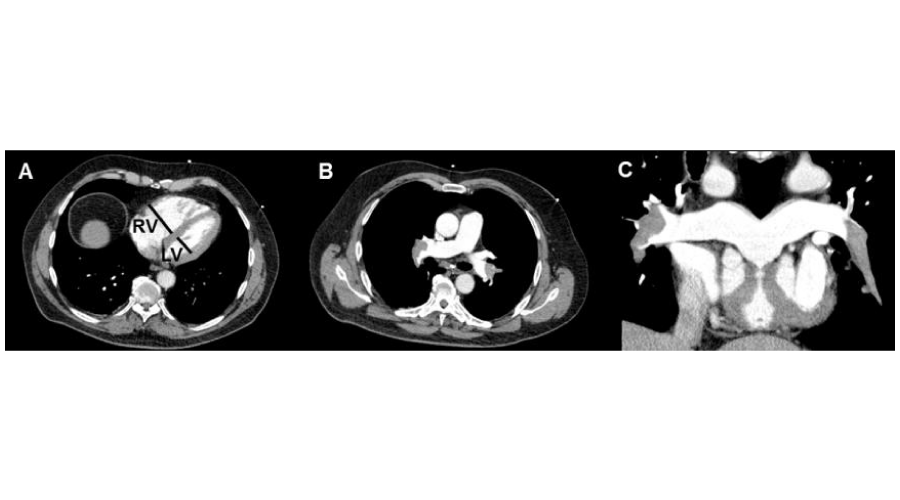
A 70-year-old male presented with two days increasing dyspnea. His past medical history was notable for deep venous thrombosis with consecutive pulmonary embolism (PE). Diagnostic workup showed normal blood pressure (130/80mmHg), sinus tachycardia with SIQIII-pattern on electrocardiogram, and elevation of troponin (0.22ng/nl). Immediate chest computed tomography (CT) demonstrated PE in both pulmonary arteries (PA) and right ventricular (RV) dilation compatible with PE of intermediate-high risk for early mortality (Figure 1).
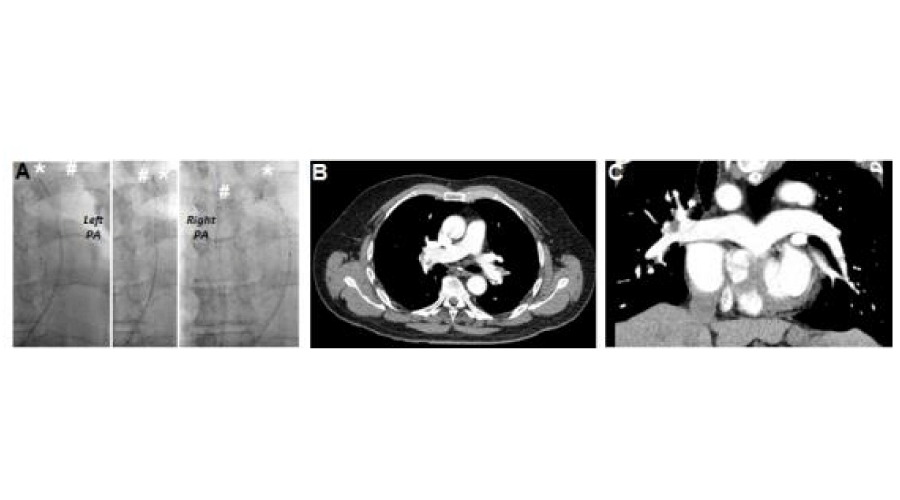
Since patients with PE at intermediate risk have mortality rates of 3-15% and recent data have shown that ultrasound-assisted catheter-directed thrombolysis (USAT) is superior to anticoagulation alone in early reversing RV dilation [1]. In comparison to this report in which bilateral embolism was treated with simultaneous application of two thrombolytic catheters connected to two external ultrasound units, we decided to perform bilateral USAT using the same thrombolysis-catheter with a staged infusion protocol since the patient was hemodynamically stable. For this purpose, an ultrasound-assisted catheter (EkoSonic MACH4e Endovascular System, EKOS Corporation, Bothwell, WA) was positioned into the left lower PA-branch via the right femoral vein and rtPA-thrombolysis was administered over 16h (0.8mg/hour) until the next morning. On the next day, a second venous access was placed into the left femoral vein and with the help of a 6F-right-amplatz-catheter, the thrombolysis-catheter was twisted around and maneuvered from the left into the right PA (Video 1) applying the same rtPA-protocol (0.8mg/hour) over 18h until the following day. Chest-CT-scan thereafter confirmed almost complete resolution of bilateral PE and normalization of RV-dimensions (Figure 2). Staged ultrasound-assisted thrombolysis using one catheter-system and a dedicated endovascular maneuver for aseptic catheter-positioning is highly efficient and cost-effective in treating bilateral PE with intermediate-high risk for early mortality.
- Kucher N, Boekstegers P, Müller OJ, Kupatt C, Beyer-Westendorf J, et al. (2014) Randomized, controlled trial of ultrasound-assisted catheter-directed thrombolysis for acute intermediate-risk pulmonary embolism. Circulation 129: 479-486.

 Save to Mendeley
Article Alerts
Subscribe to our articles alerts and stay tuned.
 This work is licensed under a Creative Commons Attribution 4.0 International License.


Video 1:
Positioning of the left-sided thrombolysis-catheter by using a right-amplatz-catheter twisted around which results in a foreshortening of the lysis-catheter which then was directed into the right PA and protruded into the final distal position after untwisting the guiding catheter.
Video 1: Positioning of the left-sided thrombolysis-catheter by using a right-amplatz-catheter twisted around which results in a foreshortening of the lysis-catheter which then was directed into the right PA and protruded into the final distal position after untwisting the guiding catheter.