International Journal of Dermatology and Clinical Research
Emergence of New Behaviors in Autism Spectrum Disorder: A Conceptual Framework for Understanding and Supporting Behavioral Change
1UMEÅ Universitet, Sweden
2Frösunda Omsorg AB, Stockholm, Sweden
3Hässelby-Vällingby Stadsdelsförvaltning, Stockholm, Sweden
4Avdelningen För Vuxna, Boende Vuxen LSS Och Socialpsykiatri, Hässelby-Vällingby stadsdelsförvaltning, Stockholm, Sweden
5Kista torg 3, Stockholm, Sweden
Author and article information
Cite this as
Sahebi M, et al. Emergence of New Behaviors in Autism Spectrum Disorder: A Conceptual Framework for Understanding and Supporting Behavioral Change. Int J Dermatol Clin Res. 2026; 12(1): 28-42. Available from: 10.17352/ijdcr.000059
Copyright License
© 2026 Sahebi M, et al. This is an open-access article distributed under the terms of the Creative Commons Attribution License, which permits unrestricted use, distribution, and reproduction in any medium, provided the original author and source are credited.Purpose: The emergence of new behaviors in autism spectrum disorder (ASD) presents ongoing challenges for caregivers and clinicians, particularly in individuals with limited verbal communication. This paper aims to reframe such behaviors as meaningful expressions of underlying needs and to propose a structured conceptual framework for understanding and responding to behavioral change.
Methods: This study adopts a conceptual and integrative approach, synthesizing existing literature alongside observational insights to develop the Behavior Emergence Matrix (BEM). The framework draws on established models, including Antecedent–Behavior–Consequence (ABC) analysis, needs-based communication theory, and dynamic systems perspectives.
Results: The proposed BEM organizes behavioral, contextual, and temporal patterns into a structured format that may support more consistent interpretation of emergent behaviors. Unlike traditional caregiver logs, the framework emphasizes pattern recognition, contextual thresholds, and alignment with caregiver response strategies. While preliminary examples illustrate its potential utility, the framework remains conceptual and requires empirical validation.
Conclusions: This paper advocates a shift from reactive behavior management toward interpretive and anticipatory care grounded in understanding behavior as communication. The BEM provides a foundation for future research integrating longitudinal caregiver data, physiological signals, and machine learning approaches. Further empirical studies are needed to evaluate its predictive utility and clinical applicability.
Autism Spectrum Disorder (ASD) encompasses a complex constellation of developmental, neurological, behavioral, and social differences that manifest uniquely in each individual. Among the more unpredictable features of autism is the emergence of new behaviors over time—some appearing abruptly, others evolving gradually—spanning a wide spectrum in form and intensity. Crucially, many of these behaviors are not inherently problematic; rather, they often represent vital expressions of unmet needs, emotional dysregulation, or efforts at self-regulation, particularly in individuals with limited verbal communication. Empirical studies have underscored this link, demonstrating that difficulties in emotion regulation are strongly associated with self-injurious and repetitive behaviors in ASD, suggesting that such behaviors frequently serve as vehicles for communicating distress or coping with overwhelming internal states.
The emergence of new behaviors in autism thus presents both challenges and opportunities. On one hand, these shifts may disrupt established routines, educational plans, or care strategies, potentially increasing stress for both individuals and their support networks. On the other hand, they offer valuable windows into the internal experiences and adaptive strategies of autistic individuals who may struggle to convey their needs directly. Gaining a deeper understanding of when, why, and how new behaviors arise is essential for caregivers, educators, clinicians, and researchers. It also opens pathways to developing conceptual framework and tailored interventions that can enhance quality of life and mitigate the risk of crisis escalation.
According to Sahebi et al. [1], physical activity and emotional support can reduce medication dependence in individuals with ASD. Their research indicates that structured exercise can reduce stereotypical behaviors by 20–30% and improve social skills, which may be a critical factor in understanding the emergence of new behaviors [1]. This paper seeks to investigate the emergence and temporal course of new behaviors in autism, explore their potential underlying causes—particularly those linked to unmet needs or communicative barriers—and propose a conceptual framework for predicting behavioral change. By synthesizing current research with theoretical and observational insights, this work aims to advance both the academic understanding of behavioral trajectories in ASD and the practical strategies available to those providing care. The novelty of this work lies in integrating structured behavioral pattern tracking with explicit caregiver response strategies within a longitudinal conceptual framework, thereby extending traditional observational approaches toward more systematic interpretation of behavioral change.
Problem statement (Problemformulering)
The appearance of new or unexpected behaviors in autistic individuals often generates significant concern among families and professionals. Such behaviors may emerge at various life stages, sometimes abruptly and sometimes more insidiously, and can persist for short durations or become enduring features. Clarifying the conditions under which these behaviors typically arise is critical to preventing crisis escalation, alleviating unnecessary distress, and ensuring that autistic individuals receive support that is both timely and appropriate.
Accordingly, this study addresses two primary questions:
- Under what conditions whether internal (such as developmental transitions or health-related changes) or external (including environmental or relational factors) are new behaviors most likely to emerge in autistic individuals, and what is the expected duration of these behaviors?
- How can caregivers, through informed observation and the use of predictive tools, better anticipate and respond to these behaviors in ways that minimize distress and enhance the overall well-being of the autistic individual?
It is important to note that this paper does not empirically answer these questions but instead proposes a conceptual framework intended to guide future research addressing them. By engaging with these questions, this paper seeks to contribute to an important gap in the literature by integrating a lifespan perspective with practical, caregiver-oriented approaches. In doing so, it aims to offer a conceptual contribution to both scientific understanding and everyday practices that directly affect the lives of autistic individuals and their support networks.
Literature review
Early-onset and later-emerging behaviors
Autism-related behaviors typically first manifest in early childhood, often through hallmark features such as repetitive motor movements (e.g., hand-flapping, rocking), circumscribed interests, social communication difficulties, and pronounced sensory sensitivities [2]. Yet accumulating longitudinal evidence indicates that new behaviors may also surface considerably later during adolescence or even adulthood frequently in conjunction with developmental transitions, heightened social expectations, or shifting environmental contexts [3,4].
In a large-scale trajectory analysis, Fountain et al. [3] identified distinct patterns of behavioral development among children with ASD, revealing that some experienced late-onset symptoms or notable fluctuations in adaptive functioning across time. Likewise, Taylor and Seltzer [5] demonstrated that while certain individuals show gradual improvements in social engagement and behavioral symptoms, others display a worsening of existing challenges or the emergence of entirely new behaviors patterns particularly evident during transitions out of structured educational settings into less predictable adult environments [5].
Collectively, these studies underscore the dynamic and evolving nature of autism, challenging the notion of static behavioral profiles or strictly bounded diagnostic categories. Instead, they highlight how behavioral trajectories are continuously shaped by complex interactions between intrinsic developmental processes and extrinsic environmental demands. This dynamic perspective underscores the necessity for ongoing assessment and the provision of individualized, adaptive supports throughout the lifespan.
Self-injury and aggression
Self-injurious behavior (SIB) and aggression represent two of the most extensively studied and clinically significant forms of challenging behavior in autism. Epidemiological data indicate that approximately 42% of children with ASD engage in some form of SIB during their development [6], while an estimated 53% exhibit aggression directed toward others or objects [7]. These behaviors are frequently linked to a confluence of factors, including communication difficulties, heightened frustration, sensory overload, or underlying medical issues such as gastrointestinal discomfort or disrupted sleep.
Longitudinal investigations reveal that although some individuals may gradually outgrow these behaviors, a substantial proportion continue to experience them well into adolescence and adulthood. Richards et al. [6,8], for instance, reported that in nearly half of affected individuals, SIB persisted for up to a decade particularly when associated with profiles characterized by low adaptive functioning and elevated impulsivity. Such findings emphasize the potential chronicity of these behaviors and the importance of long-term monitoring and intervention.
Early behavioral precursors and escalation trajectories: Recent studies further underscore that high-intensity behaviors such as severe aggression or SIB often do not arise in isolation but are preceded by discernible patterns of low-intensity behavioral changes. For example, subtle increases in pacing, heightened vocalizations, or intensified repetitive movements frequently serve as early indicators. Soke et al. [9] demonstrated that elevated irritability and hyperactivity scores could predict the emergence of aggression within a 6- to 12-month window [10] instead demonstrated that sleep patterns are predictive of next-day challenging behaviors, highlighting the importance of physiological regulation in behavioral emergence [10]. Identifying these early shifts holds considerable promise for preventative care. By recognizing and responding to cumulative minor stress signals such as a 50% rise in stimming frequency over the course of a week caregivers and clinicians may be able to intervene proactively, potentially deflecting progression toward crisis-level behaviors. These insights directly inform the conceptual foundation of our proposed predictive matrix, which seeks to operationalize such thresholds into practical tools for early detection and tailored support.
Stimming and repetitive behaviors
Stimming referring to repetitive self-stimulatory behaviors such as hand-flapping, spinning objects, or humming is a hallmark feature of autism that generally emerges in early childhood and often persists throughout the lifespan. Unlike aggression or self-injury, stimming is frequently benign and may even serve critical adaptive functions. A growing body of research suggests that these behaviors operate as intrinsic coping mechanisms, enabling individuals to modulate sensory input, regulate emotional arousal, or manage anxiety [11]. Recognizing stimming as a form of self-regulation rather than inherently problematic is essential for fostering supportive environments that respect neurodivergent expressions while remaining attentive to shifts that may indicate escalating distress.
Although stimming may become more socially adapted or decrease in intensity with age, it seldom disappears entirely. Crucially, shifts in the frequency, duration, or form of stimming often signal elevated stress, sensory overload, or an underlying mismatch between the individual and their environment. As such, changes in stimming patterns can serve as important early indicators for caregivers and professionals, highlighting the need to assess and adjust contextual demands before more disruptive behaviors emerge.
Pathological demand avoidance (pda)
Pathological Demand Avoidance (PDA) is a proposed subprofile within the autism spectrum, characterized by an intense avoidance of everyday demands, elevated anxiety, and often pronounced use of social strategies such as mimicry or distraction to resist compliance [12]. Although PDA is not formally recognized within the DSM-5, it has garnered increasing clinical and research interest, particularly in the UK and select international contexts, due to its distinct behavioral presentation.
Empirical studies on PDA remain sparse, especially regarding its developmental trajectory and long-term outcomes. Nonetheless, both clinical reports and caregiver accounts suggest that demand-avoidant behaviors are highly dynamic, often intensifying during periods of heightened stress or when individuals perceive threats to their autonomy [13]. Conceptualizing PDA-related behaviors as expressions of underlying anxiety and a need for control rather than deliberate defiance shifts intervention priorities toward relationship-centered, low-demand approaches that emphasize collaboration, choice, and co-regulation.
Internal bodily states and alexithymia: Emerging research underscores that many individuals on the autism spectrum experience reduced interoceptive awareness—that is, difficulty perceiving internal bodily signals—as well as alexithymia, characterized by challenges in identifying and describing their own emotions [14]. These intertwined difficulties suggest that behaviors such as sudden aggression, self-injury, or food refusal may not merely be responses to external events but rather attempts to cope with poorly understood internal discomfort, including gastrointestinal distress, headaches, or escalating anxiety. Murphy further propose that recurrent, seemingly inexplicable behaviors might represent expressions of “felt but not understood” bodily states. This perspective invites a broader interpretive lens, expanding beyond external environmental triggers to encompass concealed physiological or affective contributors [15]. By incorporating these insights, practitioners and caregivers are encouraged to adopt a more needs-based framework for understanding new or escalating behaviors. Such an approach emphasizes the importance of systematically considering unrecognized pain, sensory overload, or other internal discomforts before attributing behavioral changes solely to external demands or relational dynamics.
Unexpected talents and positive deviance
A subset of individuals on the autism spectrum exhibit striking or highly developed abilities, frequently in domains such as mathematics, music, visual arts, or exceptional memory—phenomena often described under the umbrella of “savant abilities.” Although prevalence estimates differ across studies, it is generally suggested that approximately 10% of individuals with ASD may display such specialized skills [16]. These talents, while sometimes perceived as isolated strengths, can also serve important self-regulatory or communicative functions, offering avenues for expression and mastery that compensate for challenges in other areas of functioning. Recognizing and nurturing these abilities not only supports individual well-being but also reframes autism within a more balanced narrative that acknowledges both vulnerabilities and unique competencies.
In addition to well-defined talents, some individuals with autism exhibit other unexpected behaviors, such as the spontaneous acquisition of a second language or hyperlexia an early and intense fascination with reading. Notably, these behaviors may arise later in development, further challenging deficit-focused models of autism by highlighting the profound variability and latent potential within neurodivergent trajectories. Incorporating such phenomena into a more comprehensive framework of behavioral emergence not only enriches clinical understanding but also broadens societal perspectives on autism, moving beyond pathology to recognize diverse expressions of growth and capability.
Additionally, the concept of positive deviance drawn from systems theory suggests that certain unexpected talents observed in individuals with autism may emerge precisely because of neural reorganization following earlier regressions or atypical developmental pathways [17]. This perspective reframes what might initially appear as developmental vulnerabilities into potential precursors for novel cognitive or creative strengths. Such an interpretation underscores the importance of adopting a dynamic, systems-oriented view of neurodevelopment that accommodates both challenges and unanticipated areas of growth.
Framing these emergent skills within the lens of neurodiversity [18] shifts the narrative away from pathology, emphasizing instead the rich adaptive capacities embedded within autistic cognition. This dual recognition acknowledging both the vulnerability to novel challenges and the remarkable potential for distinctive forms of growth reinforces the need for dynamic, individualized conceptual framework. Such models honor the complexity of autistic development, supporting approaches that are responsive not only to risks but also to evolving strengths.
Protective factors and stabilizing influences
While much of the literature emphasizes the risks and persistence of challenging behaviors, it is equally critical to recognize protective factors that can mitigate or even prevent the emergence of new behavioral concerns. McConachie et al for example, demonstrated that the use of structured routines, predictable environments, and consistent visual supports significantly reduced the incidence of new-onset aggression in children navigating the transition to secondary education. Such findings highlight the stabilizing influence of environmental scaffolding, underscoring the value of proactive, individualized supports in buffering against stressors that might otherwise precipitate behavioral escalation [19].
Likewise, research on functional communication training (FCT) demonstrates that equipping individuals with alternative means to express their needs can substantially reduce the likelihood of escalation into harmful behaviors [20]. By embedding such protective factors within conceptual framework, the approach to care shifts from being solely reactive to one that actively fosters resilience. This perspective emphasizes prevention and empowerment, positioning proactive skill-building as integral to reducing the incidence of challenging new behaviors.
Profound ASD and challenging behaviors
Profound autism spectrum disorder (ASD), characterized by either non-verbal or minimally verbal communication or an IQ below 50, accounts for approximately 26.7% of the ASD population [21]. Notably, this subgroup includes a higher proportion of females compared to the broader ASD cohort [21]. Children with profound ASD are significantly more likely to present with self-injurious behaviors (SIB) and seizures and typically require continuous, 24-hour care [22]. Interestingly, while aggression is prevalent across all ASD subgroups, its occurrence does not consistently align with the severity of the diagnosis, suggesting that additional physiological or environmental factors contribute to the manifestation of challenging behaviors [21].
Individuals with profound ASD frequently require continuous, full-time support yet remain notably underrepresented in research, a gap that recently led the CDC to establish a distinct classification for profound autism [23]. Compared to those with non-profound ASD, individuals in this subgroup demonstrate substantially higher rates of self-injurious behaviors (36.5% vs. 24.9%), while rates of aggression appear similarly elevated across both groups, at approximately 50% [21]. These findings underscore the necessity for targeted studies and tailored interventions addressing the unique needs of this underserved population.
Interestingly, the frequency of challenging behaviors does not consistently correlate with autism severity as measured by the Autism Diagnostic Observation Schedule, Second Edition (ADOS-2), nor with developmental levels assessed by instruments such as the Mullen Early Learning Composite (ELC) [24]. From a behavioral perspective, challenging actions in ASD frequently function either as mechanisms for escaping or avoiding demands, or as forms of automatic reinforcement that occur independently of the social environment [25]. Moreover, elevated negative affectivity in early childhood has been shown to predict a higher frequency of challenging behaviors later in development (Shields & Cicchetti, 1998)[24]. Appreciating these underlying behavioral functions is essential for designing interventions that are both targeted and effective.
Methods
Research design and purpose
This is not a systematic review; rather, it is a conceptual synthesis intended to generate hypotheses for future research.This paper adopts a conceptual and integrative approach, synthesizing existing literature and observational insights to propose a theoretical framework. No primary empirical data are presented.
Insights informed by existing longitudinal studies, clinical case reports, and caregiver-reported observations;
Conceptual development of a structured framework grounded in the practical concerns of caregivers, with potential to inform future predictive approaches;
A conceptual framework informed by the Antecedent–Behavior–Consequence (ABC) model, needs-based theories of behavior, and dynamic developmental systems perspectives.
Sahebi et al. [1] identify that individuals with ASD raised in institutional settings show 2.3 times higher rates of emotional dysregulation compared to those raised in family homes. This could be a contributing cause to the development of new adaptive or maladaptive behaviors. Although this paper does not present new primary data due to sample and logistical constraints, it offers a comprehensive theoretical model intended to guide future empirical investigations. Its central aim is to predict when new behaviors are most likely to emerge and to inform how caregivers might interpret and respond to these behaviors in ways that support the well-being of individuals with autism.
The observational insights presented in this paper are drawn from routine care observations conducted by the authors in their professional capacities as caregivers and support staff. These observations were not collected as part of a formal research study, and no primary empirical data are presented
Behavior tracking and classification
This study proposes categorizing observed behaviors into three overarching groups:
1. Core ASD Behaviors: Typically present from early life and relatively stable over time.
Examples: echolalia, restricted interests, sensory seeking.
2. Emergent or New Behaviors: Behaviors that appear at later developmental stages or increase in frequency/intensity without precedent.
Examples: aggression, social withdrawal, spontaneous artistic production, episodes resembling pathological demand avoidance (PDA).
3. Crisis or Unmet Need Signals: Behaviors that suggest acute stress, physiological discomfort, or a breakdown in usual communication strategies.
Examples: sudden onset of self-injury, persistent food refusal, intense vocal outbursts.
Each documented behavior is systematically coded by the timing of its emergence (infancy, childhood, adolescence, or adulthood), allowing for a developmental analysis of patterns.
To offer a structured synthesis, Table 1 summarizes representative examples, their typical age of onset, likely duration, and common triggering contexts. This operationalizes the three primary categories outlined above and serves as a quick reference for interpreting behavior across developmental stages.
For application in practical settings, a caregiver behavior log template is provided in Appendix A, designed to support systematic tracking of antecedents, observed behaviors, consequences, and relevant contextual notes. This tool aims to enhance caregiver insight and inform more tailored support strategies.
Duration is categorized as short-term (<1 week), medium-term (1 week–6 months), or long-term (>6 months), Trigger context captures situational factors such as environmental changes, increased social demands, or sensory overload, Associated outcomes may include hospitalization, initiation of new interventions, or spontaneous resolution.
For consistency in classification across future research, detailed definitions and illustrative case examples for each behavior category are provided in Appendix B.
Data sources and review strategy
This study synthesizes insights from multiple data streams to inform the proposed predict behavioral change. Key sources included:
- Longitudinal cohort studies such as the Autism Phenome Project and Simons Simplex Collection, which provide developmental trajectories and phenotypic variability across the lifespan.
- Clinical case series and qualitative caregiver interviews, including studies like O’Nions et al. [13], to capture context-rich behavioral observations often absent from quantitative datasets.
- Meta-analyses and systematic reviews examining the prevalence, persistence, and functional characteristics of behaviors such as self-injury and demand avoidance [6].
- Reports and position papers from autism advocacy organizations, alongside insights drawn from moderated caregiver forums, offering lived-experience perspectives that may highlight underreported behavioral patterns.
A structured literature search was performed using combinations of the following terms in academic databases (PubMed, PsycINFO, Scopus, Google Scholar) and grey literature repositories: (‘autism’ OR ‘ASD’) AND (‘behavioral change’ OR ‘emergent behavior’ OR ‘new onset’ OR ‘self-injury’ OR ‘demand avoidance’ OR ‘regression’ OR ‘communication breakdown’).
Inclusion/Exclusion Criteria: Inclusion: Peer-reviewed empirical studies, systematic reviews, meta-analyses, clinical case reports, and position papers from advocacy organizations published in English between 2000 and 2025 that addressed behavioral emergence, change, or prediction in ASD.
Exclusion: Studies focused exclusively on pharmacological interventions, studies without clear relevance to behavioral emergence or caregiver support, and non-peer-reviewed sources unless they provided unique lived-experience perspectives
This strategy ensured both breadth (capturing diverse presentations across age and support needs) and depth (incorporating high-detail qualitative accounts critical for needs-based interpretation).
Handling of Conflicting Findings: Where findings conflicted, we prioritized larger-scale longitudinal studies and systematic reviews, while acknowledging the limitations of small-sample or cross-sectional studies. Discrepancies are noted in the relevant sections (e.g., Section 2.7 regarding the relationship between autism severity and challenging behaviors)
Theoretical framework
The conceptual foundation of this study draws upon an integrated framework that combines three complementary perspectives:
ABC Model (Antecedent → Behavior → Consequence): This behavior analytic model structures observation around identifying triggers (antecedents), the specific behavioral response, and subsequent outcomes (consequences). It facilitates systematic detection of patterns that may precede or reinforce emergent behaviors.
Needs-Based Communication Theory: This perspective reframes behavior—especially sudden or challenging behaviors—not as mere disruption, but as an alternative form of communication, often expressing unmet needs, discomfort, or emotional dysregulation. It underscores the importance of interpreting behavior within relational and functional contexts.
Dynamic Systems Theory: Recognizing that development is neither linear nor uniform, this lens highlights how multiple interacting factors (biological, environmental, relational) produce context-sensitive and sometimes unpredictable changes over time. It accommodates the nonlinear emergence of new behaviors and the possibility of spontaneous adaptation or resolution.
Together, these perspectives support a nuanced understanding of why new behaviors arise in autism, how they evolve, and what caregivers might anticipate. They also inform the proposed predictive matrix by emphasizing multilevel interactions across antecedent conditions, communicative intent, and broader developmental dynamics. While existing tools such as ABC logs and standardized behavioral scales provide valuable snapshots of behavior, they are often limited by infrequent recording and lack of longitudinal integration. In contrast, the BEM emphasizes continuous pattern tracking and the integration of multiple data sources over time, allowing for a more dynamic understanding of behavioral change.
Toward a conceptual framework for future conceptual framework
Building on the combined insights of behavioral, communicative, and developmental frameworks, this paper outlines preliminary directions for the conceptual development of a Behavior Emergence Matrix (BEM).
Behavior Emergence Matrix (BEM): The BEM should be understood as an early-stage conceptual framework rather than a validated framework for future prediction. Its primary function is to organize observational data in a structured manner, forming a foundation for future research that may incorporate predictive analytics.
The core aim of the BEM is to provide a structured conceptual framework that integrates observational, contextual, and physiological data to support the anticipation of behavioral change, including the emergence or escalation of behaviors in individuals with autism.
Recent pilot studies highlight the potential for developing predictive approaches in this domain. For example, [26] demonstrated that wearable sensors tracking heart rate variability and electrodermal activity have shown potential to identify physiological patterns associated with subsequent behavioral escalation with over 80% accuracy up to one hour in advance. Incorporating similar data streams into the BEM could inform the future development of real-time, personalized support systems, which may support caregivers in implementing de-escalation strategies proactively. However, these findings are preliminary and require replication in larger, more diverse samples before they can be translated into clinical practice.
The proposed BEM framework includes the following components:
- Contextual risk tracking: systematically logs environmental, relational, and internal factors that increase behavioral vulnerability (e.g., transitions, novel demands, sleep disruptions).
- Escalation monitoring: captures progression from subtle signals (e.g., increased stimming) to more overt avoidance or aggressive behaviors, which may help identify patterns of gradual behavioral escalation.
- Threshold flagging: operationalizes risk with concrete rules such as: “If communication breakdowns occur three or more times per week alongside sensory distress rated ≥6/10, this pattern may warrant increased attention as a potential indicator of emerging behavioral challenges, although such thresholds are hypothetical and require empirical validation”.
Future directions involve the integration of app-based caregiver logging platforms coupled with machine learning approaches to explore and refine potential predictive capabilities over time. Such tools could contribute to the development of more dynamic and adaptive support systems tailored to individual profiles.
Table 2 below synthesizes how each theoretical model contributes to the conceptual underpinnings of the BEM, ensuring that both immediate situational factors and long-term developmental trajectories inform prediction and support.
The development of frameworks that may support future predictive system holds promise for enabling caregivers to implement more proactive and informed interventions, potentially improving safety for individuals with ASD. However, challenges remain in minimizing false alarms, ensuring data privacy, and achieving wide acceptance by individuals with ASD and their families.
Wearable sensor approaches
Wearable sensors have been increasingly investigated as tools to detect physiological states linked to challenging behaviors in autism. Early studies employing electrocardiogram (ECG), electrodermal activity (EDA), electromyography (EMG), and skin temperature have shown promising results, achieving approximately 80% accuracy in predicting affective states such as anxiety and engagement, albeit often in small-scale samples [27,28]. Heart rate (HR) monitoring, in particular, has demonstrated notable utility. Studies with preschool-aged children with ASD have reported moderate predictive success, with area under the receiver operating characteristic curve (AUROC) values ranging from 0.72 to 0.91 for anticipating stress responses and challenging behaviors in the period leading up to meltdowns [26]. Such findings underscore the potential of integrating physiological data streams into anticipatory care models, offering a means to detect escalating distress before overt behavioral manifestations occur. [29] advanced this work by integrating heart rate, galvanic skin response, and skin temperature data into a hybrid convolutional neural network–long short-term memory (CNN-LSTM) architecture, achieving a remarkable 96% accuracy in predicting meltdowns. This underscores the substantial promise of deep learning approaches for enhancing predictive capability in autism-related behavioral monitoring. Nonetheless, these studies frequently rely on small sample sizes, and physiological-behavioral relationships often vary markedly across individuals. Such variability highlights the critical importance of developing personalized modeling strategies tailored to each person’s unique physiological and behavioral patterns [30].
Movement sensor approaches
Beyond physiological monitoring, accelerometers and gyroscopes have been extensively utilized to detect stereotypical motor movements (SMMs) and aggressive behaviors in individuals with ASD. Studies employing wrist- and torso-mounted accelerometers combined with machine learning classifiers including support vector machines (SVM), convolutional neural networks (CNN), and hidden Markov models (HMM)—have reported detection accuracies ranging from approximately 70% to over 90% [31,32] demonstrated that CNNs, particularly when enhanced through transfer learning, substantially outperformed traditional classifiers in identifying SMMs among children with autism. Sensor placement significantly influences detection efficacy: wrist-worn devices often excel at capturing hand-flapping, whereas sensors positioned on the back more effectively detect behaviors such as body rocking [33]. Despite these promising advances, user tolerance remains a considerable hurdle, especially for sensors placed on the ankle or torso, which are more frequently rejected or removed by participants [34]. Taken together, these findings highlight both the technological promise and the practical limitations of movement sensor approaches, underscoring the importance of individualized calibration and user-centered design in future applications aimed at predicting or mitigating challenging behaviors.
Non-wearable and manual data approaches
Non-wearable sensing methods, such as video-based behavior analysis and ambient environmental sensors, offer valuable, less intrusive alternatives for monitoring behaviors in individuals with autism. When integrated with wearable data streams, these approaches can cross-validate detected events and help identify environmental antecedents, such as changes in lighting, noise, or social density that might precipitate behavioral episodes [34]. Manual recording methods, particularly functional behavior assessments (FBA) employing structured antecedent-behavior-consequence (ABC) logs, continue to represent the gold standard for elucidating the functional relationships underlying challenging behaviors [35]. However, these techniques are inherently labor-intensive, often require significant training to implement reliably, and can be subject to observer bias.
Future directions point toward hybrid models that combine manual FBA with continuous sensor-based data streams. Such integration could significantly improve both the precision and timeliness of detecting and predicting emergent behaviors, ultimately supporting earlier, more targeted interventions.
Findings and visualization concepts
This section synthesizes key insights from the reviewed literature and introduces conceptual tools designed to assist caregivers and professionals in visualizing and interpreting behavioral trajectories over time. The proposed visual models emphasize timelines, triggers, behavioral transitions, and corresponding care responses, thereby structuring complex observations into more interpretable formats for practical use.
The Behavior Emergence Matrix (BEM) is proposed as a structured conceptual framework for organizing and interpreting behavioral observations over time. It is designed to capture relationships between antecedents, behaviors, contextual variables, and caregiver responses in a longitudinal manner, with the aim of supporting more consistent interpretation of emerging behavioral patterns.
Unlike traditional caregiver logs, which are often descriptive and retrospective, the BEM introduces structured pattern recognition, contextual thresholds, and explicit links between observed behaviors and caregiver response strategies.
Table 3 presents a streamlined version of the proposed Behavior Emergence Matrix (BEM). This matrix integrates contextual risk factors with likely short-term behavioral outcomes, alongside tailored recommendations for caregiver interventions. By systematically linking frequently observed constellations of stressors such as recurrent communication breakdowns or significant environmental transitions to patterns of emergent behavior, the BEM serves as an initial scaffold for developing more sophisticated predictive tools.
By visualizing the convergence of multiple low-level stressors that may push an individual across a behavioral threshold, the BEM highlights opportunities for early, preventative support rather than crisis-driven reaction.
The development of the BEM involves several conceptual steps. First, recurring behavioral patterns and antecedent conditions are identified through caregiver observations or existing records. Second, these observations are organized into structured categories, including contextual factors (e.g., environmental changes, routines), behavioral indicators (e.g., withdrawal, agitation), and response outcomes. Third, patterns are examined over time to identify recurring associations that may indicate emerging behavioral trends. Finally, these patterns are linked to potential caregiver response strategies, forming a structured framework for interpretation and action.
The framework allows incorporation of multiple types of variables, including behavioral observations, environmental context, communication factors, physiological indicators (when available), and caregiver-reported interpretations. The flexibility of the framework enables adaptation across different care settings and levels of data availability.
Future iterations of this matrix could be dynamically populated through app-based caregiver logs and wearable sensor data, ultimately enabling personalized, real-time risk forecasting. Such integration represents a promising pathway toward translating theoretical models into tangible, caregiver-friendly framework for future prediction.
Behavioral observations and hypothesis on function of new behaviors
Observed New Behaviors and Contextual Factors: Over the past several months, a range of new or intensified behaviors have been observed in the individual under study. These behaviors vary in duration and frequency, and appear linked to distinct contextual or physiological factors. These observations were made during routine care provision and were documented as part of standard caregiver practice. No identifying information is presented, and all details have been anonymized to protect the individual’s privacy. All names, dates, locations, and other potentially identifying details have been removed or altered to protect the anonymity of the individual described. Specific behavioral descriptions are presented solely for illustrative purposes and do not correspond to any single identifiable person.
Several studies cited in Sahebi et al. [1] show that activities like swimming, martial arts, and horseback riding improve motor skills, reduce anxiety, and increase social interaction. These findings support the idea that new positive behaviors can be promoted through well-chosen physical activities. Table 4 summarizes these observations, including hypothesized functions and relevant contextual notes.
These observations illustrate the interplay between environmental factors (such as seasonal changes), interpersonal dynamics (e.g., staff responsiveness), and possible internal drivers (including sensory needs and emotional regulation).
Understanding these behaviors as potentially communicative or regulatory rather than merely disruptive can guide more nuanced support strategies. For example, behaviors like rubbing the nose until bleeding may indicate unmet needs for attention or misunderstood communication, whereas foot stamping or seeking the navel may serve as self-organizing mechanisms during periods of uncertainty.
Future sections will integrate these findings with the proposed Behavior Emergence Matrix (BEM) to identify thresholds at which multiple contextual factors may converge, increasing the likelihood of more severe behavioral escalation.
Interpretation and Link to predict behavioral change: Taken together, these observations underscore the dynamic, multifactorial nature of emergent behaviors in autism, particularly within the context of profound ASD. Many of the newly noted behaviors appear to serve self-regulatory or communicative functions in response to internal discomforts (such as sensory needs or emotional uncertainty) or external circumstances (including variations in staff interaction and seasonal environmental changes).
By systematically documenting these behaviors alongside potential triggers and hypothesized functions, this case illustration directly informs the utility of the proposed Behavior Emergence Matrix (BEM). Recognizing patterns such as the convergence of reduced social engagement, increased sensory seeking, and environmental stressors may allow caregivers and professionals to anticipate periods of heightened risk and intervene proactively.
These observations reinforce the importance of viewing new behaviors within a broader context that includes individual sensory needs, emotional regulation, environmental shifts, and interpersonal dynamics. By linking these case-specific patterns to the proposed predictive matrix, we highlight practical pathways for anticipating and addressing emerging behaviors.
The following section will explore these implications in greater detail, emphasizing how conceptual framework grounded in individual behavioral histories and contextual data can advance more responsive, personalized care strategies.
Hypothesis on Function of These New Behaviors: ased on systematic observation, it appears that many of these new or intensified behaviors serve as adaptive or communicative strategies in response to unmet needs most notably, a lack of attention or meaningful engagement. For minimally verbal individuals, such behaviors may become the primary means to secure responses from caregivers or to self-regulate sensory and emotional states.
Attempting to simply suppress these behaviors without addressing their underlying drivers risks prompting the emergence of alternative, potentially more harmful actions. Instead, staff and caregivers should first consider what the individual might be trying to communicate or manage through these behaviors. By interpreting these actions within a needs-based framework, interventions can be tailored to provide more appropriate forms of support, thereby reducing reliance on maladaptive strategies.
Case Examples Illustrating These Relationships: Hair Pulling and Hand Biting
These behaviors notably intensified during periods of reduced direct interaction, suggesting they are primarily attention-maintained. Rather than viewing these actions solely as problems to eliminate, they can be understood as clear signals seeking engagement or reassurance from staff.
Implication: Caregivers should be encouraged to consider: “Is this behavior an attempt to draw me in? How can I proactively offer interaction or comfort to meet this need before it escalates?”
Seasonal Shifts in Mood and Clothing: Observations revealed that the onset of colder, darker months coincided with signs of low mood or depression, while warmer weather led to increased efforts to remove clothing, potentially tied to discomfort or hormonal changes (such as menopause). These examples illustrate how environmental and physiological factors can directly influence behavioral expression.
Implication: Incorporating strategies such as increased light exposure during winter and adjusting expectations around clothing in hot weather may help preempt these patterns and improve comfort.
Nose Rubbing and Staff Influence: Self-injurious nose rubbing occurred more frequently depending on which staff members were present. This suggests that differences in caregiver style, attentiveness, or ability to read early stress signals may directly impact the individual’s comfort and likelihood of engaging in self-injury.
Implication: Training staff to recognize subtle precursors of agitation and to respond promptly with supportive interaction could help reduce progression to more severe behaviors.
To consolidate these observations, Table 5 summarizes the key behaviors, their likely functions, and suggested support strategies, providing a practical reference for staff and caregivers Table 5.
Integrating Observations into Prediction and Prevention: These insights strongly support the idea that behavioral prediction systems whether based on wearable physiological signals (heart rate, skin conductance) or environmental/contextual data (who is present, time of day, recent interactions) should be personalized to the individual’s unique behavioral ecology. For example:
- An increase in subtle self-touching (e.g., hand-to-face) might predict escalation to nose rubbing or hair pulling.
- Lower light levels or higher indoor temperatures could signal an increased risk for mood-related or disrobing behaviors.
Such individualized modeling, combined with staff logs and functional behavior assessments (FBA), would allow prediction systems to move beyond generic thresholds to real-time, context-aware alerts, improving both safety and quality of care.
To illustrate these relationships in a practical format, Table 4 summarizes key observed behaviors, their likely functions, and recommended proactive responses, serving as a quick guide for staff and caregivers.
Advanced data-driven models and machine learning
Recent developments in machine learning have substantially advanced the capacity to detect and predict challenging behaviors in autism. Hybrid deep learning models, such as convolutional neural network–long short-term memory (CNN-LSTM) architectures, have achieved prediction accuracies of up to 96% for meltdown events when using physiological sensor data [29]. Recent developments in machine learning have substantially advanced the capacity to detect and predict challenging behaviors in autism. Hybrid deep learning models, such as convolutional neural network–long short-term memory (CNN-LSTM) architectures, have achieved prediction accuracies of up to 96% for meltdown events when using physiological sensor data [34]. Ensemble approaches that integrate multiple physiological streams, including EEG and autonomic measures, have also demonstrated strong performance in distinguishing affective states [36]. However, despite these promising results, most studies to date have been limited by small sample sizes or controlled research settings. This underscores the critical need for larger, ecologically valid trials that embed these conceptual framework into daily care environments. Combining multiple data modalities such as heart rate, skin conductance, movement sensors, and contextual variables (e.g., staff presence, time of day) and customizing algorithms to individual physiological and behavioral profiles appear essential for achieving reliable, real-world prediction. Figure 1 visually represents the multi-layered predict behavioral change proposed in this paper. Physiological, movement, and contextual data streams are continuously collected and fed into advanced machine learning models, which integrate these inputs with manually logged behavioral records. This approach allows the system to generate both short-term risk alerts (e.g., anticipating escalation to self-injury) and longer-term behavioral insights (e.g., increased vulnerability during seasonal changes). Such models illustrate how combining wearable and non-wearable data sources with individual behavioral ecology can move care from reactive crisis management to proactive, person-centered support. Future research should also prioritize the development of explainable AI models that can provide caregivers and clinicians with transparent, interpretable insights into why a particular prediction was made, thereby fostering trust and facilitating clinical decision-making[30,35].
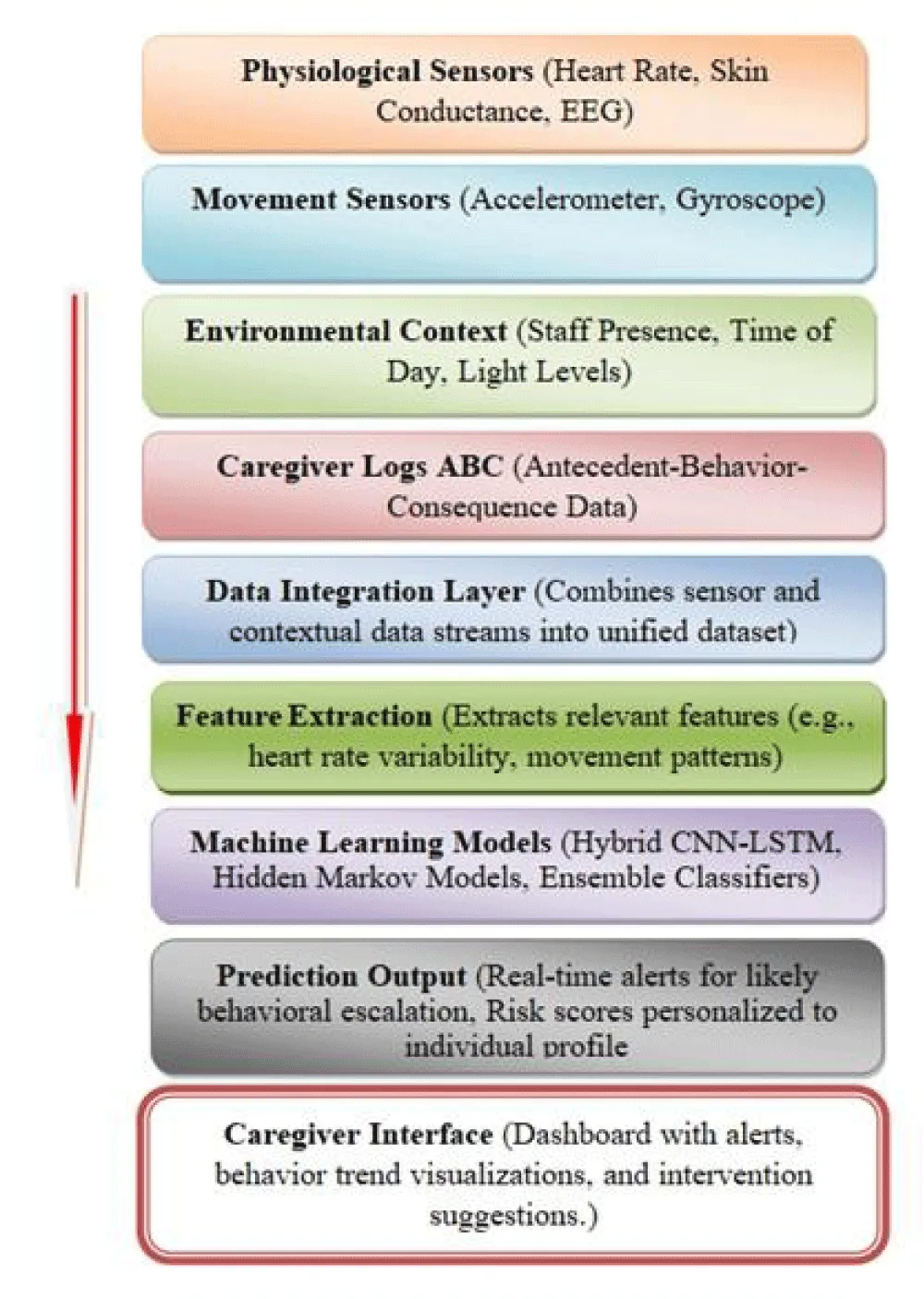
Figure 1 visually represents the multi-layered predict behavioral change proposed in this paper. Physiological, movement, and contextual data streams are continuously collected and fed into advanced machine learning models, which integrate these inputs with manually logged behavioral records. This approach allows the system to generate both short-term risk alerts (e.g., anticipating escalation to self-injury) and longer-term behavioral insights (e.g., increased vulnerability during seasonal changes). Such models illustrate how combining wearable and non-wearable data sources with individual behavioral ecology can move care from reactive crisis management to proactive, person-centered support.
This flowchart illustrates how physiological signals (e.g., heart rate variability, skin conductance), movement patterns (e.g., accelerometer-detected stereotypy), contextual/environmental data (e.g., light levels, temperature, caregiver interactions), and manual behavior logs are integrated through machine learning models such as CNN-LSTM or HMM architectures. The system generates real-time alerts when escalation is likely (e.g., progression from self-touching to self-injury) and provides ongoing dashboards for behavioral insights, enabling personalized, proactive intervention. The approach underscores the importance of multimodal, individualized data in predicting and preventing challenging behaviors.
In practice, caregivers may use the BEM by regularly recording observed antecedents, behaviors, and contextual factors, reviewing patterns over time, and linking these patterns to appropriate response strategies. This iterative process supports ongoing refinement of behavioral understanding rather than one-time assessment.
Discussion
Interpretation of key patterns
The emergence of new behaviors in individuals with autism is not random, but rather appears to follow identifiable patterns tied to internal regulation challenges and external demands. For example:
- New aggressive behaviors are often preceded by prolonged frustration and reduced communicative effectiveness.
- Demand avoidance (especially PDA-like behaviors) tends to intensify in environments with inflexible expectations or during transitions.
- Spikes in stimming or unusual talents often correlate with elevated sensory input, anxiety, or emotional shifts.
These findings reinforce the theory that many new behaviors are compensatory manifesting not as symptoms of deterioration but as creative, albeit disruptive, forms of adaptation.
Behavioral emergence as communication
Central to this paper is the principle that behavior is a form of communication, particularly in non-verbal or minimally verbal autistic individuals. When the ability to express needs is restricted due to stress, environment, cognitive load, or regression new behaviors may “speak” for the person:
- A child who begins head-banging may be expressing gastrointestinal discomfort.
- A previously verbal adolescent who suddenly withdraws socially may be experiencing executive function overload.
- A rise in spontaneous art or scripting may represent an attempt to process emotions or reclaim predictability.
Recognizing behaviors as communicative can transform caregiver and clinician approaches—from controlling or extinguishing behaviors to decoding and responding to them.
Predictive utility of behavior mapping
The proposed Behavior Emergence Matrix (BEM) offers a conceptual starting point for real-time behavioral monitoring. When supported by longitudinal tracking (e.g., parent logs, app-based inputs), it could allow caregivers to:
- Detect early signs of escalation
- Implement proactive strategies before crisis behaviors emerge
- Assess which environmental or relational factors are triggering specific behaviors
By converting behavioral data into temporal, contextual, and emotional maps, caregivers can become “behavioral translators” able to anticipate needs before distress behaviors erupt.
Recent advances in machine learning demonstrate that integrating physiological signals (such as heart rate and skin conductance) with contextual data dramatically improves the accuracy of predicting meltdowns or aggression. This underscores the potential for caregiver logs and BEM outputs to directly complement wearable or environmental sensors in future studies. Such hybrid systems could create individualized conceptual framework that move beyond general thresholds to person-specific indicators of escalation
Challenges and ethical considerations
Several challenges complicate the creation of a reliable conceptual framework:
- High variability between individuals: What signifies distress for one autistic person may be neutral or even enjoyable for another.
- The risk of pathologizing positive divergence: Not all “new” behaviors are negative or need intervention.
- The potential for over-monitoring: Families and professionals must avoid turning prediction into surveillance, maintaining respect for autonomy and privacy.
Therefore, tools developed from this research must be flexible, person-centered, and focused on understanding rather than normalization.
Furthermore, real-world deployment of these predictive technologies must contend with issues such as sensor tolerance (particularly for ankle or torso devices), data privacy, and minimizing false alarms that could unnecessarily disrupt daily activities. Maintaining respect for the individual’s autonomy and comfort remains paramount.
Implications for caregiver practice
For caregivers, clinicians, and educators, the following principles emerge:
- Expect change. New behaviors are developmentally typical within autism and often signify a changing internal or environmental state.
- Track context. Time of day, sensory load, and relational dynamics provide valuable clues.
- Prioritize connection. Before intervention, validate emotion and offer choice or co-regulation.
- Use the matrix. Simple tools like a week-long log or BEM checklist may improve pattern recognition, though empirical validation is required.
- Train for translation. Caregivers should be taught how to “listen” to behavior as a language—not only in moments of distress, but across the routine flow of life.
Implementation of this framework would require caregiver training to ensure consistent interpretation of behaviors and antecedents. Differences in perception between caregivers and professionals represent a potential limitation. To aid in routine monitoring, Appendix C includes a structured weekly caregiver checklist designed to highlight changes in communication, sensory tolerance, or health that might precede behavioral shifts.
The effectiveness of the framework depends on consistent and accurate input from caregivers. As such, clear guidance and training may be required to ensure reliable identification of antecedents, behaviors, and outcomes, as well as consistency across different observers.
Limitations
The proposed framework has not been empirically tested, and its predictive capabilities remain hypothetical. Validation through longitudinal and experimental studies is necessary. Although this paper incorporates detailed observational data from individual cases, these remain preliminary illustrations rather than statistically validated datasets. Systematically combining such case-based behavioral logs with physiological monitoring could form a template for future large-scale studies. It is important to note that variability in caregiver interpretation may affect the consistency of recorded data, representing a potential limitation of the framework. The literature synthesis was not conducted as a systematic review; therefore, selection bias may be present. However, we have attempted to be transparent about our search strategy and inclusion criteria to facilitate reproducibility.While this paper offers a comprehensive framework for understanding and predicting emergent behaviors in individuals with autism, several limitations must be acknowledged:
Limited Empirical Data on Rare Behaviors: Although longitudinal studies provide valuable insights into common behavioral trajectories, data on rare or late-onset behaviors such as sudden language acquisition or severe regression in adulthood remain sparse. This limits the generalizability of proposed models, especially for individuals at the extremes of the autism spectrum or those with co-occurring conditions.
Lack of Primary Data Collection: Due to the scope and design of this paper, we did not include new field data or real-time behavior tracking from participants. As such, the proposed conceptual framework, matrices, and thresholds are conceptual and hypothesis-generating rather than statistically validated. Future studies should incorporate large-scale caregiver logs and behavior-sensing tools (e.g., wearable tech) to empirically test these models.
Heterogeneity of Autism Spectrum: ASD is not a single condition but a spectrum encompassing a wide range of abilities, communication styles, and neurological profiles. The same environmental factor (e.g., a noisy classroom) may produce very different behavioral responses across individuals. Therefore, any conceptual framework must be personalized, which limits universal applicability.
Risk of Over-Pathologizing Positive Change: Some emergent behaviors such as scripting, stimming variations, or newly discovered talents are not signs of distress but positive adaptations. Over-interpreting all behavioral change as a “problem to solve” risks diminishing neurodivergent expressions and reinforcing deficit-based thinking.
Cultural and Contextual Biases: Most cited studies originate from high-income, English-speaking countries. Cultural factors, caregiving styles, and societal expectations play a substantial role in how behaviors are expressed, perceived, and addressed. Broader cross-cultural data is needed to enrich and validate the findings and proposed tools.
Additional illustrative visualizations of behavior timelines and stress-response “heat maps” are presented in Appendix D, providing a conceptual blueprint for future empirical data visualization.
Current state of behavior prediction research
Although numerous studies have identified physiological and psychological correlates associated with the presence or frequency of challenging behaviors, these are often limited to cross-sectional or single time-point analyses. For caregivers and individuals with ASD, however, the ability to predict the timing of challenging behaviors in real-world settings is crucial, as these episodes can disrupt daily activities, medical appointments, and pose risks of injury [35]. There exists a literature gap in real-time, naturalistic behavior prediction and intervention, especially for children with ASD. Thus, integrating individualized behavioral tracking with multimodal sensor inputs holds promise for closing this gap, paving the way for person-centered predictive tools that can be tested and refined in naturalistic environments.
Conclusion and future directions: integrating ethics and anticipatory care in autism
The development of frameworks that may support framework for future prediction holds promise for enabling caregivers to implement more proactive and informed interventions, potentially improving safety for individuals with ASD. However, challenges remain in minimizing false alarms, ensuring data privacy, and achieving wide acceptance by individuals with ASD and their families. Personalization of conceptual framework, continuous longitudinal monitoring, and integration with established behavioral interventions such as functional behavior assessment (FBA) are critical future directions to translate sensor-based prediction technologies into clinical practice [30,35].
In our own observations, many newly emerging behaviors ranging from playing with and pulling out hair, to rubbing the nose until it bleeds, biting the hand, or seeking tactile input from the navel appeared to function as individualized communication strategies. Often, these were tied to unmet needs such as attention, a search for security, or attempts at sensory self-regulation. This underscores the necessity of framework for future prediction that are not only technologically robust but also deeply contextual, integrating qualitative caregiver insights and relational dynamics alongside data from sensors or machine learning outputs.
The emergence of new behaviors in individuals with autism is both a challenge and an opportunity. As this paper has shown, these behaviors often arise in response to unmet needs, environmental mismatches, or internal changes that are difficult to express through conventional communication particularly for those with limited verbal ability. Rather than being seen solely as disruptive or pathological, new behaviors can be viewed as adaptive signals, part of an evolving developmental trajectory.
By systematically classifying behaviors, identifying common antecedents, and building predict behavioral change, we can support caregivers and clinicians in understanding why a behavior appears, how long it may persist, and what kind of response is most helpful. Tools such as the proposed Behavior Emergence Matrix (BEM) offer a way to anticipate these behaviors and personalize interventions. Moreover, integrating needs-based communication models encourages a more empathetic, relational approach to autism support.
Still, this research is only a beginning. More empirical data ”especially caregiver-reported logs and longitudinal behavior tracking” is needed to validate and refine conceptual framework. Cross-cultural, neurodiversity-affirming studies will also help ensure the inclusivity and ethical integrity of future tools. Most importantly, collaboration with autistic individuals themselves is essential to ground our interpretations in lived experience, not assumptions.
This paper’s combined approach documenting detailed observations of newly emerging behaviors alongside an exploration of physiological prediction, may serve as an early template for multi-layered monitoring systems. Such frameworks could empower caregivers and clinicians to map new behaviors against possible biological, relational, and environmental drivers, improving both anticipation and individualized support.
Understanding emergent behavior in autism should not aim to eliminate difference but to respect it. The goal is not prediction for control, but for compassion: to recognize the moments when behavior becomes language, when escalation is a cry for co-regulation, and when new behaviors whether distress signals or unexpected talents reveal the evolving story of an autistic person’s interaction with the world. As emphasized by Sahebi et al. [1], physical activity should be integrated as a core component of habilitation to prevent the escalation of behavioral problems and reduce dependence on psychotropic medications.
Statements and declarations
The authors declare that no funds, grants, or other support were received for the preparation of this manuscript. The authors have no relevant financial or non-financial interests to disclose. Data sharing is not applicable to this article as no new empirical data were created or analyzed in this study. This is a theoretical and conceptual paper that synthesizes existing literature and presents observational case examples. This article does not contain any studies with human participants or animals performed by any of the authors. The observational data presented are based on routine care observations and do not constitute formal research requiring ethical approval. All potentially identifying details have been minimized, and appropriate anonymization has been documented. No consent was required as no identifiable data are presented; however, the authors affirm that all observations were conducted in accordance with professional ethical standards and respect for the individual’s dignity and autonomy.
Acknowledgments
The authors would like to acknowledge the caregivers and support staff whose daily observations and insights contributed to the conceptual development of this work.
- Sahebi, M., Tamdjidi, M., Thorell, J., & Parisa, A. (2025). Physical Activity and Addressing Emotional Needs Can Help Reduce Medication Dependence in Autism. Frontiers in Psychology, 16, 1509827. Available from: https://doi.org/10.3389/fpsyg.2025.1509827
- Lolk, A. (2013). Neurokognitive lidelser Diagnostic and statistical manual of mental disorders: American Psychiatric Association.
- Fountain, C., Winter, A. S., & Bearman, P. S. (2012). Six developmental trajectories characterize children with autism. Pediatrics, 129(5), e1112-e1120. Available from: https://doi.org/10.1542/peds.2011-1601
- Simonoff, E., Pickles, A., Charman, T., Chandler, S., Loucas, T., & Baird, G. (2008). Psychiatric disorders in children with autism spectrum disorders: prevalence, comorbidity, and associated factors in a population-derived sample. Journal of the American Academy of Child & Adolescent Psychiatry, 47(8), 921-929. Available from: https://doi.org/10.1097/chi.0b013e318179964f
- Taylor, J. L., & Seltzer, M. M. (2010). Changes in the autism behavioral phenotype during the transition to adulthood. Journal of autism and developmental disorders, 40, 1431-1446. Available from: https://doi.org/10.1007/s10803-010-1005-z
- Richards, C., Oliver, C., Nelson, L., & Moss, J. (2012). Self-injurious behaviour in individuals with autism spectrum disorder and intellectual disability. Journal of Intellectual Disability Research, 56(5), 476-489. Available from: https://doi.org/10.1111/j.1365-2788.2012.01537.x
- Kanne, S. M., & Mazurek, M. O. (2011). Aggression in children and adolescents with ASD: Prevalence and risk factors. Journal of Autism and Developmental Disorders, 41, 926-937. Available from: https://doi.org/10.1007/s10803-010-1118-4
- Murphy, G. H., Beadle-Brown, J., Wing, L., Gould, J., Shah, A., & Holmes, N. (2005). Chronicity of challenging behaviours in people with severe intellectual disabilities and/or autism: A total population sample. Journal of Autism and Developmental Disorders, 35(4), 405-418. Available from: https://doi.org/10.1007/s10803-005-5030-2
- Soke, G. N., Rosenberg, S. A., Hamman, R. F., Fingerlin, T. E., Rosenberg, C. R., Carpenter, L., et al. (2019). Prenatal, perinatal, and neonatal factors associated with self-injurious behaviors in children with autism spectrum disorder. Research in Autism Spectrum Disorders, 61, 1-9.
- Cohen, S., Fulcher, B. D., Rajaratnam, S. M., Conduit, R., Sullivan, J. P., St Hilaire, M. A., et al. (2018). Sleep patterns predictive of daytime challenging behavior in individuals with low‐functioning autism. Autism Research, 11(2), 391-403. Available from: https://doi.org/10.1002/aur.1899
- Kapp, S. K., Steward, R., Crane, L., Elliott, D., Elphick, C., Pellicano, E., et al. (2019). ‘People should be allowed to do what they like’: Autistic adults’ views and experiences of stimming. Autism, 23(7), 1782-1792. Available from: https://doi.org/10.1177/1362361319829628
- Newson, E., Le Marechal, K., & David, C. (2003). Pathological demand avoidance syndrome: a necessary distinction within the pervasive developmental disorders. Archives of Disease in Childhood, 88(7), 595-600. Available from: https://doi.org/10.1136/adc.88.7.595
- O’Nions, E., Viding, E., Greven, C. U., Ronald, A., & Happé, F. (2014). Pathological demand avoidance: exploring the behavioural profile. Autism, 18(5), 538-544. Available from: https://doi.org/10.1177/1362361313481861
- Shah, P., Catmur, C., & Bird, G. (2016). Emotional decision-making in autism spectrum disorder: the roles of interoception and alexithymia. Molecular Autism, 7, 1-10. Available from: https://doi.org/10.1186/s13229-016-0104-x
- Murphy, J., Brewer, R., Catmur, C., & Bird, G. (2017). Interoception and psychopathology: A developmental neuroscience perspective. Developmental Cognitive Neuroscience, 23, 45-56. Available from: https://doi.org/10.1016/j.dcn.2016.12.006
- Treffert, D. A. (2009). The savant syndrome: an extraordinary condition. A synopsis: past, present, future. Philosophical Transactions of the Royal Society B: Biological Sciences, 364(1522), 1351-1357. Available from: https://doi.org/10.1098/rstb.2008.0326
- Happé, F., & Vital, P. (2010). What aspects of autism predispose to talent? Autism and Talent, 364(1522), 29. Available from: https://doi.org/10.1098/rstb.2008.0332
- Milton, D. E. (2012). On the ontological status of autism: The ‘double empathy problem’. Disability & Society, 27(6), 883-887.
- McConachie, H., Livingstone, N., Morris, C., Beresford, B., Le Couteur, A., Gringras, P., et al. (2018). Parents suggest which indicators of progress and outcomes should be measured in young children with autism spectrum disorder. Journal of Autism and Developmental Disorders, 48, 1041-1051. Available from: https://doi.org/10.1007/s10803-017-3282-2
- Tiger, J. H., Hanley, G. P., & Bruzek, J. (2008). Functional communication training: A review and practical guide. Behavior Analysis in Practice, 1, 16-23. Available from: https://doi.org/10.1007/bf03391716
- Hughes, M. M., Shaw, K. A., DiRienzo, M., Durkin, M. S., Esler, A., Hall-Lande, J., et al. (2023). The prevalence and characteristics of children with profound autism, 15 sites, United States, 2000-2016. Public Health Reports, 138(6), 971-980. Available from: https://doi.org/10.1177/00333549231163551
- Wachtel, L. E., Escher, J., Halladay, A., Lutz, A., Satriale, G. M., Westover, A., et al. (2024). Profound autism: An imperative diagnosis. Pediatric Clinics, 71(2), 301-313. Available from: https://doi.org/10.1016/j.pcl.2023.12.005
- Moss, P., Howlin, P., Savage, S., Bolton, P., & Rutter, M. (2015). Self and informant reports of mental health difficulties among adults with autism findings from a long-term follow-up study. Autism, 19(7), 832-841. Available from: https://doi.org/10.1177/1362361315585916
- Shields, A., & Cicchetti, D. (1998). Reactive aggression among maltreated children: The contributions of attention and emotion dysregulation. Journal of Clinical Child Psychology, 27(4), 381-395. Available from: https://doi.org/10.1207/s15374424jccp2704_2
- Tarbox, J., Wallace, M. D., Tarbox, R. S., Landaburu, H. J., & Williams, W. L. (2004). Functional analysis and treatment of low‐rate problem behavior in individuals with developmental disabilities. Behavioral Interventions: Theory & Practice in Residential & Community-Based Clinical Programs, 19(2), 73-90.
- Goodwin, M. S., Mazefsky, C. A., Ioannidis, S., Erdogmus, D., & Siegel, M. (2019). Predicting aggression to others in youth with autism using a wearable biosensor. Autism Research, 12(8), 1286-1296. Available from: https://doi.org/10.1002/aur.2151
- Gao, X., Yin, L., Tian, S., Huang, Y., & Ji, Q. (2024). Wearable technology for signal acquisition and interactive feedback in autism spectrum disorder intervention: A review. IEEE Sensors Journal.
- Goodwin, M. S., Özdenizci, O., Cumpanasoiu, C., Tian, P., Guo, Y., Stedman, A., et al. (2018). Predicting imminent aggression onset in minimally-verbal youth with autism spectrum disorder using preceding physiological signals. Paper presented at the Proceedings of the 12th EAI International Conference on Pervasive Computing Technologies for Healthcare.
- Khullar, V., Singh, H. P., & Bala, M. (2021). Meltdown/Tantrum detection system for individuals with autism spectrum disorder. Applied Artificial Intelligence, 35(15), 1708-1732.
- Cano, S., Cubillos, C., Alfaro, R., Romo, A., García, M., & Moreira, F. (2024). Wearable Solutions Using Physiological Signals for Stress Monitoring on Individuals with Autism Spectrum Disorder (ASD): A Systematic Literature Review. Sensors, 24(24), 8137. Available from: https://doi.org/10.3390/s24248137
- Al-Rammah, F., Masmoudi, M., & Jarraya, S. K. (2022). Cnn-lstm based approach for analyzing and detecting stereotypical motor movements of autistic children in pre-meltdown crisis. Paper presented at the 2022 IEEE/ACS 19th International Conference on Computer Systems and Applications (AICCSA).
- Rad, N. M., Kia, S. M., Zarbo, C., van Laarhoven, T., Jurman, G., Venuti, P., et al. (2018). Deep learning for automatic stereotypical motor movement detection using wearable sensors in autism spectrum disorders. Signal Processing, 144, 180-191.
- Laurie, C. (2022). Sensory and motor strategies: practical ways to help autistic children and young people learn and achieve: Jessica Kingsley Publishers.
- Arbili, O., Rokach, L., & Cohen, S. (2025). Wearable Sensors for Ensuring Sports Safety in Children with Autism Spectrum Disorder: A Comprehensive Review. Sensors, 25(5), 1409.
- Cannon, J., O'Brien, A. M., Bungert, L., & Sinha, P. (2021). Prediction in autism spectrum disorder: A systematic review of empirical evidence. Autism Research, 14(4), 604-630. Available from: https://doi.org/10.1002/aur.2482
- Lee, H.-y., Hu, T.-y., Jing, H., Chang, Y.-F., Tsao, Y., Kao, Y.-C., et al. (2013). Ensemble of machine learning and acoustic segment model techniques for speech emotion and autism spectrum disorders recognition. Paper presented at the INTERSPEECH.



 Save to Mendeley
Article Alerts
Subscribe to our articles alerts and stay tuned.
 This work is licensed under a Creative Commons Attribution 4.0 International License.