International Journal of Dermatology and Clinical Research
Successful Treatment of Annular Elastolytic Giant Cell Granuloma with Tranilast and Topical Glucocorticoid under the Strict Restriction of Sun Exposure
1Takagi Dermatological Clinic, Japan
2Department of Dermatology, Asahikawa Medical University, Japan
3Department of Dermatology, Housui Medical Center, Japan
Author and article information
Cite this as
Takahashi H, Satoh K, Takagi A, Ishida-Yamamoto A, Iizuka H (2015) Successful Treatment of Annular Elastolytic Giant Cell Granuloma with Tranilast and Topical Glucocorticoid under the Strict Restriction of Sun Exposure. Int J Dermatol Clin Res. 2015; 1(2): 14-15. Available from: 10.17352/2455-8605.000006
Copyright License
© 2015 Takahashi H, et al. This is an open-access article distributed under the terms of the Creative Commons Attribution License, which permits unrestricted use, distribution, and reproduction in any medium, provided the original author and source are credited.Annular elastolylic giant cell granuloma (AEGCG) is a rare granulomatous skin disease characterized by loss of elastic fibers accompanied with elastophagocytosis by multinucleated giant cells. The clinical appearance shows annular and serpiginous plaques with hypopigmentation or skin atrophy. Ultraviolet irradiation, heat, or other unknown factors are supposed to induce pathogenic alternation [1]. The treatment for AEGCG remains unestablished and various therapeutic modalities including intralesional and systemic glucocorticoids, psoralen plus ultraviolet A irradiation, cryotherapy,retinoids, fumaric acid esters, pimecrolimus and minocycline are applied [2,3]. We report a case of AEGCG successfully treated with oral tranilast and topical glucocorticoid with sunscreens
Annular elastolylic giant cell granuloma (AEGCG) is a rare granulomatous skin disease characterized by loss of elastic fibers accompanied with elastophagocytosis by multinucleated giant cells. The clinical appearance shows annular and serpiginous plaques with hypopigmentation or skin atrophy. Ultraviolet irradiation, heat, or other unknown factors are supposed to induce pathogenic alternation [1]. The treatment for AEGCG remains unestablished and various therapeutic modalities including intralesional and systemic glucocorticoids, psoralen plus ultraviolet A irradiation, cryotherapy, retinoids, fumaric acid esters, pimecrolimus and minocycline are applied [2,3]. We report a case of AEGCG successfully treated with oral tranilast and topical glucocorticoid with sunscreens.
A 62-year-old Japanese man was referred to our clinic, because of gradually enlarging asymptomatic reddish annular plaques with raised border on right dorsal hand and neck (Figures 1a,b). No other skin or mucosal lesions were detected. Histopathological examination revealed non-palisading granulomas in the upper and mid dermis with multinucleated giant cells showing elastophagocytosis (Figure 1c). Elastica van Gieson staining confirmed reduced elastic fibers and elastophagocytosis by multinucleated giant cells (Figure 1d). Laboratory analyses, blood cell count, biochemical tests, serum levels of blood glucose, haemoglobin A1c, and angiotensin-converting enzyme were within normal limits. These clinical and histopathlogical findings led to a diagnosis of AEGCG. The patient was advised to use sunscreens and was treated with topical 0.05% betamethasone butyrate propionate ointment and oral tranilast at 300 mg/day for 10 weeks. The lesions gradually improved in two months (Figures 1e,f).
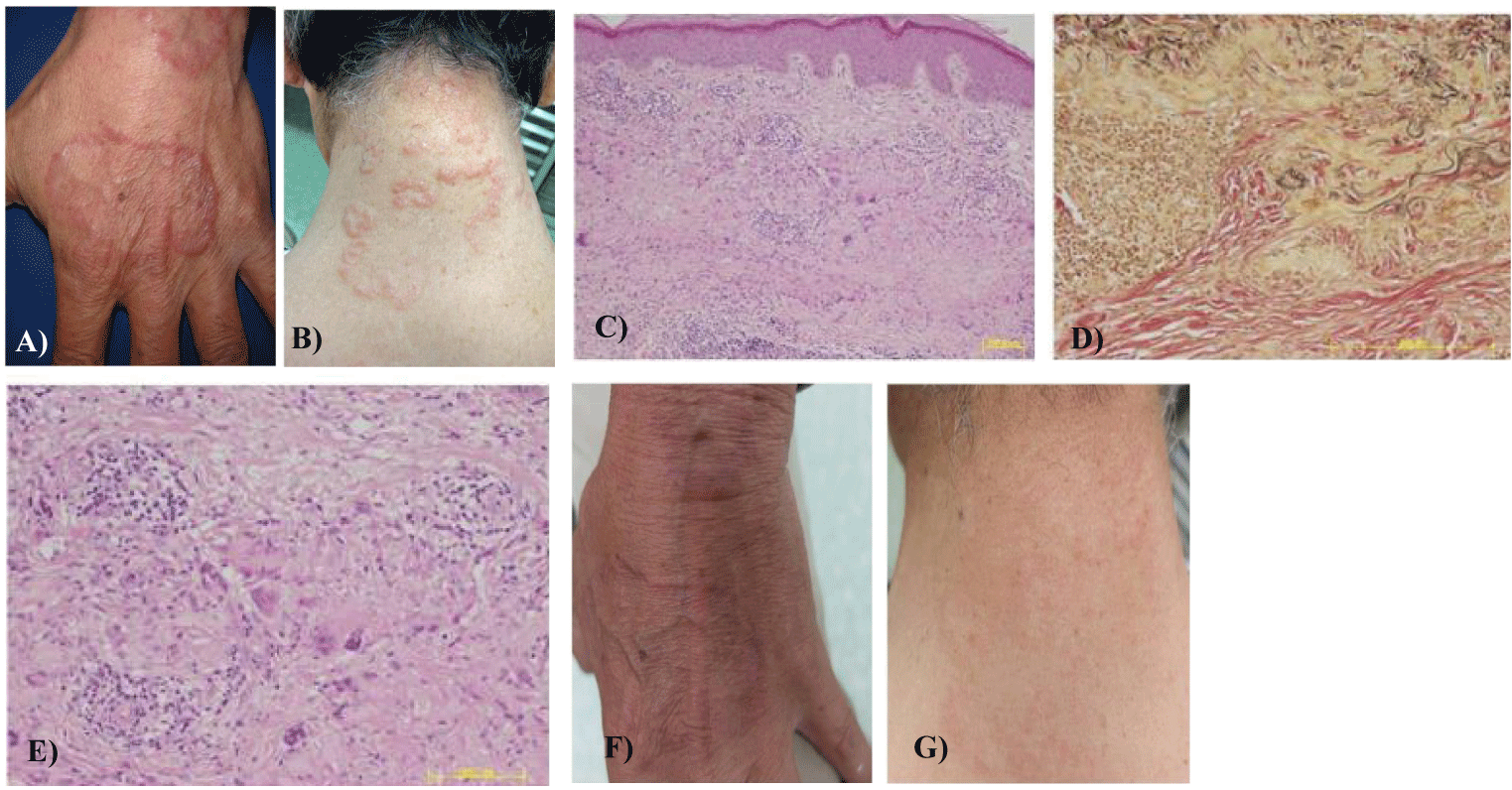
AEGCG is supposed to be induced by actinic damage of elastic fibers. However, the precise pathomechanism is still unclear. The treatment of AEGCG is empirical and no established therapy is available with inconsistent results. Tranilast is an anti-allergic drug and inhibits the release of chemical mediators including histamine and leukotriene from mast cells [4]. Furthermore, tranilast is supposed to inhibit the formation of multinucleated giant cells [5]. AEGCG were successfully treated with oral tranilast and topical pimecrolimus in an eight month Korean infant [1]. Our case showed the actinic damage of elastic fibers and was treated with oral tranilast and topical glucocorticoid under the strict restriction of sun exposure. Although AEGCG may show a spontaneous regression, oral tranilast and topical glucocorticoid with strict sun restriction by sun screen showed a remarkable clinical response in our case.
- Lee HW, Lee MW, Choi JH, Moon KC, Koh JK (2005) Annular elastolytic giant cell granuloma in an infant: improvement after treatment with oral tranilast and topical pimecrolimus. J Am Acad Dermatol 53: S244-246.
- Rongioletti F, Baldari M, Buriando M, Parodi A (2010) Papular elastolytic giant cell granuloma: report of a case associated with monoclonal gammopathy and responsive to topical tacrolimus. Clin Exp Dermatol 35: 145-148.
- Nanbu A, Sugiura K, Kono M, Muro Y, Akiyama M (2015) Annular elastolytic giant cell granuloma successfully treated with minocycline hydrochloride. Acta Derm Venereol 95: 756-757.
- Mizuno K, Okamoto H, Horio T (2000) Inhibitory influences of tranilast on multinucleated giant cell formation from monocytes by supernatant of concanavalin A stimulated mononuclear cells. J Dermtol Sci 24: 166-170.
- Morita K, Okamoto H, Miyachi Y (1999) Papular elastolitic giant cell granuloma: a clinical variant of annular elastolytic giant cell or generalized granuloma annulare? Eur J Dermatol 9: 647-649.

 Save to Mendeley
Article Alerts
Subscribe to our articles alerts and stay tuned.
 This work is licensed under a Creative Commons Attribution 4.0 International License.