International Journal of Dermatology and Clinical Research
Exudative Eroded Lesion and Fever
1Dermatology Department, Unidade Local de Saúde do Alto Minho, E.P.E., Viana do Castelo, Portugal
2Dermatology Department, Centro Hospitalar do Porto, E.P.E.-HSA, Porto, Portugal
Author and article information
Cite this as
Rosmaninho A, Carvalho S (2015) Exudative Eroded Lesion and Fever. Int J Dermatol Clin Res. 2015; 1(1): 9-9. Available from: 10.17352/2455-8605.000003
Copyright License
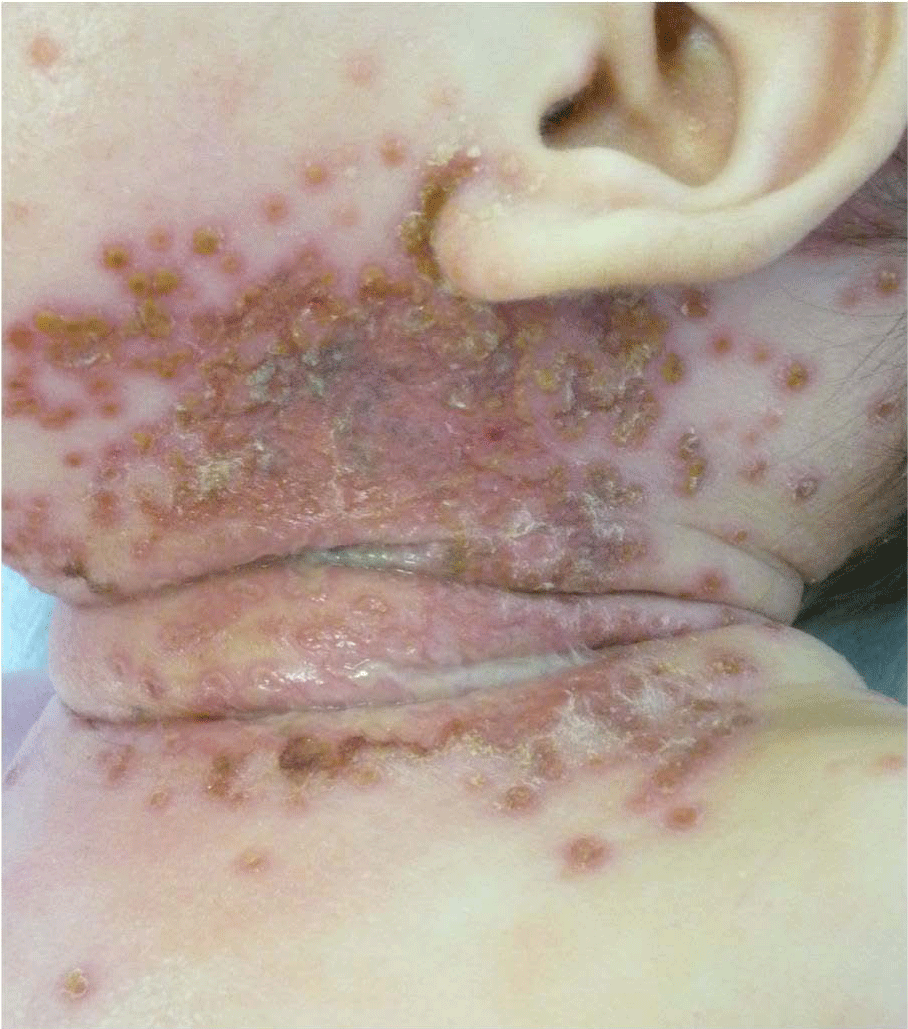
© 2015 Rosmaninho A, et al. This is an open-access article distributed under the terms of the Creative Commons Attribution License, which permits unrestricted use, distribution, and reproduction in any medium, provided the original author and source are credited.A 4 month year-old boy presented with a 5 day history of an erythematous exudative lesion on the lateral aspect of the face, neck and thorax. He had been observed by his physician and a topical fusidic acid ointment had been applied without success. His prior medical history was remarkable for an atopic dermatitis. On physical examination the patient had fever of 38.6ºC. An exudative erythematous lesion with multiple grouped peripheral umbilicated vesiculopustules and punched-out ulcers were observed on the face, neck and thorax (Figure 1). He hadn´t received vaccination in the prior 2 months. The laboratory showed no abnormalities except for an erythrocyte sedimentation rate of 19 mm/hr. A Tzanck test showed acantholytic balloon cells. A diagnosis of eczema herpeticum was made.
A 4 month year-old boy presented with a 5 day history of an erythematous exudative lesion on the lateral aspect of the face, neck and thorax. He had been observed by his physician and a topical fusidic acid ointment had been applied without success. His prior medical history was remarkable for an atopic dermatitis. On physical examination the patient had fever of 38.6ºC. An exudative erythematous lesion with multiple grouped peripheral umbilicated vesiculopustules and punched-out ulcers were observed on the face, neck and thorax (Figure 1). He hadn't received vaccination in the prior 2 months. The laboratory showed no abnormalities except for an erythrocyte sedimentation rate of 19 mm/hr. A Tzanck test showed acantholytic balloon cells. A diagnosis of eczema herpeticum was made.
Eczema herpeticum (EH) or Kaposi varicelliform eruption is a rare potentially life-threatening viral infection. Clinically, it usually presents as small grouped, monomorphic papulovesicles that eroded originating punctiform punched-out ulcers overlying an erythematous base on skin affected by a pre-existing dermatitis [1]. It may be accompanied by a flu-like syndrome of chills, fever, and malaise. Most of the cases occur concomitantly with atopic dermatitis and is caused by herpes simplex viruses (HSV 1 and 2) but Cocksackie virus A16 and vaccinia virus have also been implicated [2]. It occurs with other skin conditions such as, psoriasis, seborrheic dermatitis, burns and Darier disease [2]. The upper body is the most common site affected (mainly the head and neck), and the lesions are usually confined to the areas of the previous dermatosis [1]. Viral infection is result of auto-inoculation in a host with a latent infection or from an infected contact. The use of topical calcineurin inhibitors, commonly used in the treatment of atopic dermatitis have been associated with EH and are contraindicated during the outbreak. Secondary bacterial infection, mainly by S. aureus, may occur and may be a confounding factor, delaying the diagnosis. The clinical manifestation of EH is characteristic, but it can be confused with impetigo, eczema vaccinatum, and primary varicella infection. The diagnosis of EH is mainly clinical, however some laboratory tests can be useful. The Tzanck test is very easy and quick to perform and the microscopic finding of multinucleated giant cells with molded, jigsaw-puzzle nuclei in addition to acantholytic balloon cells favours a herpes virus infection [3]. However, is neither sensitive nor specific for HSV infection. Detection of HSV antigen is also rapid. Viral culture is both sensitive and specific for HSV, but takes at least 48 hours [3]. Systemic dissemination and viremia with multiple organ involvement may occur with mortality rates ranging from 10% to 75%. Thus, the diagnosis should be mainly clinical and treatment with antiviral drugs should not be delayed pending laboratory tests.
Acyclovir is the usual treatment, and for severe disease in immunocompromised patients, is dosed at 15 mg/kg/day intravenously for a minimum of 5 days. Pediatric patients may be treated with acyclovir 25 mg/kg/day, divided into 5 equal doses for 5 to 10 days [4].
- Fitzpatrick JE, Aeling JL (2001) Dermatology Secrets in Color (2nd ed.). Philadelphia: Hanley & Belfus; 2001.
- Wollenberg A, Wetzel S, Burgdorf W, Haas J (2003) Viral infections in atopic dermatitis: Pathogenic aspects and clinical management. J Allergy Clin Immunol 112: 667-674.
- Olson J, Robles DT, Kirby P, Colven R (2008) Kaposi varicelliform eruption (eczema herpeticum). Dermatol Online J 14: 18.
- Mackley CL, Adams DR, Anderson B, Miller JJ (2002) Eczema herpeticum: a dermatologic emergency. Dermatol Nurs 14: 307-310.


 Save to Mendeley
Article Alerts
Subscribe to our articles alerts and stay tuned.
 This work is licensed under a Creative Commons Attribution 4.0 International License.